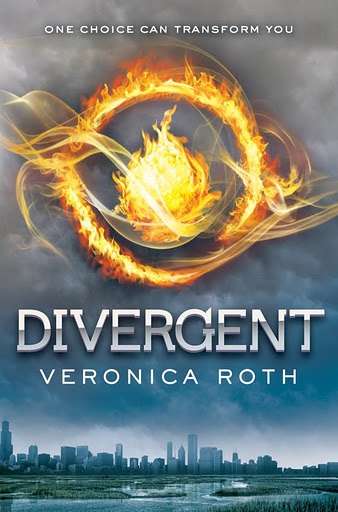
Divergent by Veronica Roth

My mood and overall outlook on life becomes glowingly positive when I read a great book.  It’s like how exercise junkies get endorphins.  Well, I swear there’s some hormone that is released in my brain after a satisfying book.

And Divergent by Veronica Roth is going to have me in a good mood for weeks.

First, you should know there are three things that I value more highly than other qualities in books.

  • Pacing
  • Characters
  • Plot

Those three things have to be there for me in my pleasure reading.  My favorite books have to be page turners, have to make me fall in love with the characters and leave me wishing they were real people, and the plot has to be plausible and intriguing.

Divergent by debut author Veronica Roth blew me away in all these categories.  Pacing, characters, and plot were all fantastic.

So without giving away any spoilers, let me tell you why you should read this book:

  1. It’s a combination of the Sorting Hat in Harry Potter, the violence and corrupt dystopian world of Hunger Games, with the vulnerability and growth of Ender in Ender’s Game.  Plus there’s romance and a male lead I swooned for way more than any Edward or Jacob.
  2. The premise: A future dystopian world where people are divided into factions based on what they believe in.  The main character, Beatrice, must decide whether to stay in the faction she grew up in or betray her family and choose a faction that better suits her.
  3. Pacing: I could not put this book down.  I lost sleep.  I took it to school with me to sneak in reading time.  At a hefty 487 pages… this shouldn’t have been a quick read, but I started it on Wednesday evening and finished it on Friday evening.
  4. Characters: Hunger Games fans might hate me for this, but I liked the main character, Beatrice, way better than I liked Katniss.  Both girls are tough and must learn to fight for their own survival.  But Beatrice came off as a much more likable character.  This may even cause me to like Divergent better than Hunger Games.  And did I mention I LOVE FOUR.  Four is the male lead.  Weird name I know.  But I love Four.  You will love him too if you read this book.
  5. Plot: I love when I get to the end of a book and see how everthing fit together so perfectly–how events at the beginning led to the ending.  Everything in this book was plausible and not forced.  I never felt like the author was throwing in some deus ex machina to save the day.

I could go into so much more detail but I don’t want to ruin this book for anyone.  I’m so glad it’s going to be a trilogy because I need more!  As soon as I was finished I wanted to go back and read it all over again.

One Warning: This book is very violent.  Lots of blood.  Lots of gore.  Suicide and murder.  I’d be hesitant to recommend it to anyone under 13.
Adverbs and Adjectives

Back into writing exercises!

I’ve hopped back into doing writing exercises from Ursula K. Le Guin’s Steering the Craft.

Today, I did exercise five which involves writing a paragraph of descriptive prose without adjectives or adverbs.

Here’s what I realized:

  1. I need to brush up on my grammar.  Throughout the exercise I was asking myself, “Is this an adjective?”  And because I was actually sitting down and writing for the first time in ages, I really didn’t want to substantially interrupt the flow of writing to look up grammar rules.  So I didn’t.  But it made me realize that since I’ve been teaching Reading instead of English for the last two years, I’ve been neglecting my grammar knowledge.  I think I might start by re-reading a little Strunk and White.
  2. The point of the exercise was to make you more conscious of choosing strong nouns and verbs and making use of simile and metaphor instead of adjectives and adverbs.  I definitely concentrated on that, and more than once found myself trading out weak choices for stronger ones.
  3. My biggest dilemma in avoiding adjectives or adverbs was in describing color, material, size, and time.  You can see below in my sample that I slipped up quite a few times.  I figured I still got what was intended out of the exercise, and didn’t want the end product to read weird.  Maybe I shouldn’t care about the product if I’m just doing an exercise, but personally, if I’m making the time to sit down and write, then I want to be at least a little happy with the result.
Here’s a sample of today’s work:
The last time I’d traveled to London was well before my parent’s death, at least six or seven years ago.  I believe I was just ten years old.  The first shock that bombards my senses is the noise.  The din of the carriage that I’d thought was so deafening on the journey is nothing compared to the onslaught of sound that pours in as we open the carriage door.  Whistles of steam, the clanging of metal, bellows of men, and the clicking of gears surround me.  My head whips around as I try to find the sources of such noises.
“Come, Anne.  Or we’ll leave you behind,” my aunt snaps.
I hurry after her, already several paces behind after standing mesmerized by the cacophony.
As I weave between women wearing corsets and men in top hats, I run my hands over my own wool dress.  The color reminds me of a gray field mouse.  The plainness of it must stand out amid the jewel tones that are so clearly in fashion–I push through a sea of people in emerald silks and purple velvet.
Just as the crowd is beginning to be too much, just as my head becomes light and my eyes have trouble focusing, my aunt turns and climbs up a short flight of stairs to a rowhouse.

Feel free to try the exercise for yourself.  It’s harder than it looks  😉

Response to Maggie’s "A Proper Education"

Maggie Stiefvater rocks my socks.  I heart her.  Glad that’s out of the way because I’m about to agree and disagree with her a little bit.

Maggie recently blogged about her education to become a writer in a post titled “A Proper Education.”

Some points I agree with, but others I don’t.

AGREE
Maggie brings up the 10,000 hour rule.  That you must spend 10,000 hours at something to become an expert in a field.  I totally agree with her on this.  People who spend the most time working at something will be the people to succeed.  It’s crystal clear to someone who is a teacher: the more time a kid spends on something, the closer they are to mastering it.

Maggie’s big argument seems to be that creative writing programs are not the end-all-be-all of getting a writing education.

“But I think that there are lots of ways to accomplish those [10,000] hours. You can self teach. You can apprentice. You can take classes. You can workshop. You can get a writing critique partner. You can steal someone else’s brain.” 

I agree that all of the above are important to a writer’s education. (Perhaps with the exception of brain stealing–  😛 )

Here’s where I start to disagree:

“I reckon before I post this, I should emphasize that I have nothing against degrees in Creative Writing. If you think you need one to keep you motivated or to structure your education, go for it. But it’s not the way I learn. And I’d wager in some cases it can do more harm to an introverted creative person’s psyche than good. But the most important thing is: they’re pretty much invisible when it comes to getting your book published. Your education, however you manage it, is the process: the book is the result. Agents, editors, readers: they don’t care how you got there, just that you did.”

The whole “if you think you need one” bit comes off a tad on the condescending side.  But knowing that she hasn’t been through a writing program, I’ll try not to hold it against her.

Because I happened to find a writing program that I consider a total blessing.  It has provided me with:

  • A nurturing creative environment
  • Companionship and writing peers that I respect
  • Mentors whose guidance has helped me develop my craft
  • Classes that have stimulated growth in me as a writer because they forced me to stretch myself outside my comfort zone
I know not everyone can afford to pay thousands of dollars to take college/graduate courses, and I should consider myself lucky that I’ve been privileged to do so.  But I really don’t think I would have grown as a writer as much as I have in the past two years without my graduate program.
I adore my graduate program.  And I do think it’s made me a better writer.
But I will concede some points she made:
  • A writing program could be damaging to someone if they don’t find the right program.  I’ve heard horror stories about elitist writing programs that do more damage than good.  Persevering through that kind of program just for a piece of paper is not worth it.  Especially if you aren’t growing as a writer and having your self-worth as a writer torn apart.
  • A piece of paper won’t necessarily mean you are more qualified.  (Though I do think it will give you some street cred.)  There will be different levels of skill coming out of my program.  One piece of paper for each of us won’t mean we’re all equally skilled.  Your work will speak for itself.  I think that comes back to the 10,000 hours thing.  People who put in more hours will be more qualified, and that includes the hours you spend putting into your coursework.  If you truly take advantage of a writing program, then you do build up hours towards your 10,000.
I know Maggie’s post was not meant to be a personal slight to writing programs.  She just wanted to say that you can become a good writer without one.
But I sincerely wish that everyone could experience what an amazing writing program can have to offer.  I was lucky enough to find a perfect fit.  🙂

The End is in Sight…

This has been one crazy autumn.  From my online grad class to big changes happening at my school, the pace of my life has left me breathless and with a twitchy eye.  (For real, my eye has been twitching for months.  Stress or exhaustion induced.)

And as much as I’ve been enjoying my grad class on Newbery books, I’m greatly looking forward to having some free time at my disposal.

And here’s why I decided to blog.  What will I be doing with said free time?

Two things.

ONE: Reading for Pleasure

My to-read list:

Scorpio Races by Maggie Stiefvater
Leviathan Trilogy by Scott Westerfeld
Divergent by Veronica Roth
Liesl and Po by Lauren Oliver
Ship Breaker by Paolo Bacigalupi

And others, but those have made their way to the top for one reason or another.

TWO: Writing (New Exciting Project)

I had a fantastic idea in July for a novel that would be a steampunk twist on a classic book.  I made myself hold off on beginning to write, thinking I would use said idea for NaNoWriMo. (Click here if you want to know what NaNoWriMo is.)  When November rolled around, I knew I couldn’t handle NaNo with the current state of my sanity (remember stress-induced twitchy eye?).  So I held off further.

And I’m glad I held off.  Here’s why.

I’ve been brainstorming in a way that I haven’t before.  I drive home to see my family pretty regularly, about an hour drive, and I’ve been turning off the radio and plotting in my head during the drives.  But I haven’t just been plotting scenes–I’ve been thinking about character arcs.  (Click here for a nifty website explaining what a character arc is.)  The story has evolved over the past 4 months, and I’m pretty tickled.

I have three arcs that interweave for my main character; three ways she will grow over the course of the book.  I have a skill based arc, a fear based arc, and a human relationship based arc.  Each arc now has a clearly outlined progression and the arcs connect with each other in a logical way.

I never would have come up with this if I’d just started writing with the initial idea in July.  I would have had a really crappy first draft.  Probably one with a decent action plot but with no emotional plot whatsoever.  Having it brew over four months like this was something I’d never done before, and I’m hoping the payoff will be great.  I’m really optimistic and eager to start writing.

I also want to give a little tip of my hat to my Writing Fantasy teacher this summer who helped me learn to pay attention to both the action plot and emotional plot.

So look forward to more posts about writing in December  🙂

Woo hoo!

The Importance of Conflict

I’m taking a class on Newbery award winning books, and I’m reading some fantastic award winning literature for children.  Some of the books are truly out-of-this-world fantastic, such as:

  • One Crazy Summer by Rita Garcia-Williams
  • Good Masters! Sweet Ladies! Voices from a Medieval Village by Laura Amy Schlitz
  • Claudette Colvin: Twice Towards Justice by Phillip Hoose

But some other books on my reading list I’m having issues with.  And they have have something in common: lack of conflict.

They’re written beautifully.  They have big themes.  They have style and voice.

But I really take issue with the lack of conflict because it makes me ask: so what?  Why are we reading about this character in this moment?  So what?  Why is this event important?  So what?  How is this character learning, changing, growing, evolving if they don’t face any challenges?  So what?  Why write this story, about this character, in this moment?

If there isn’t any conflict, then the story itself loses immediacy, urgency, and importance.  Where’s the risk? Where’s the possibility of failure?  Why should the reader root for success?  And then why should that success mean something?

Stories that lack conflict also lack pacing.  And perhaps this is why the Newbery has been criticized as being a bunch of “great” books that kids don’t read.  Pacing is critically important in engaging child readers.  Without conflict, without tension, without risk, keeping the pages turning is near impossible.

The Newbery committee typically focuses on the following criteria in literary fiction:

  • Interpretation of the theme or concept
  • Presentation of information including accuracy, clarity, and organization
  • Development of a plot
  • Delineation of characters
  • Delineation of a setting
  • Appropriateness of style.

Hmmmm.  Development of plot.  Seems to me that’s where conflict should go.  Or perhaps it could go under delineation of character. (As without testing your characters, how can you see what they’re made of?)

However, maybe conflict should get its own category.  I’d argue it’s important enough.  Aren’t some of the most memorable characters in classic literature made memorable through the challenges they face? Would Romeo and Juliet be as memorable without the feud between their two families?  Would Jane Eyre be as memorable without her internal struggle between passion and morality?  Would Pip be as memorable without the conflict between his superficial values and his conscience?

Something to think about if you’re a writer.  One of my favorite pieces of advice is: to be MEAN, be CRUEL to your characters.  Make them face their biggest fears.  Throw everything you can at them.  I love that advice.  When I do it, my characters become more alive, writer’s block isn’t a problem, and the plot moves at a steady pace.

Now if I can just get the Newbery committee to acknowledge conflict as its own crucial entity in the selection process…

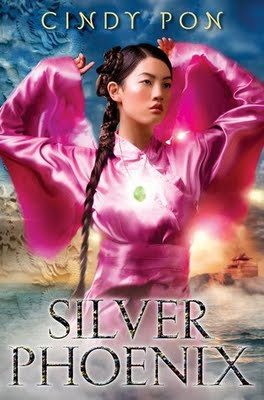
Silver Phoenix by Cindy Pon

Looking for a fresh, original high fantasy novel?  Looking for a book with a strong, complex female protagonist?  Check out Silver Phoenix by Cindy Pon.

This is one of the best fantasy novels I’ve read since Kristin Cashore’s Graceling.  Fantastic world-building, an intriguing villain (especially in the 2nd book), and fast-paced plot.  I absolutely love that this is an Asian inspired fantasy, and if you enjoyed Shannon Hale’s Book of a Thousand Days, you’ll love this!

Essential plot: Ai Ling goes off in search of her father who she fears is dead, and while on her journey, meets the handsome Chen Yong and discovers she has the power to read and control other people’s spirits. She must face a great evil who has been using other’s souls for his own immortality.

Word of Caution: I definitely could not recommend this to my 6th graders because of some mature violence and sexual themes.  But a great read for the upper YA bracket!

Note: This is a two book series.
Book One = Silver Phoenix
Book Two = Fury of the Phoenix

Meeting Maggie and SCBWI Fall Conference ’11

I had the most awesome weekend ever and am now feeling so totally in love with books and writing.  This is seriously my calling.

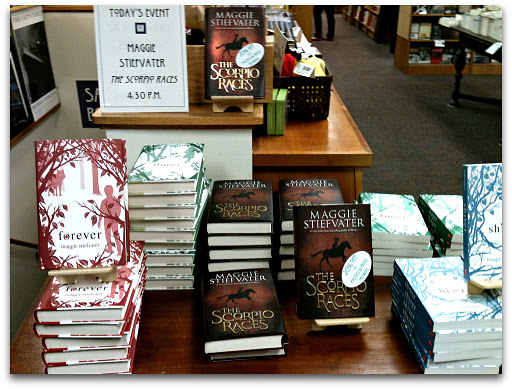
First bit of awesomeness: Meeting Maggie Stiefvater

 Maggie ranks up there in favorite authors.  She’s in the top 10.  I’ve read all of her books (BalladLamentShiverLingerForever) and follow her blog religiously (she has a fantastic sense of humor on her blog and gives great writing tips).

I’d always seemed to miss her book signings because they were in the summer while I was away at graduate school.  But her new book, The Scorpio Races, just came out this week, and she was having a launch event in DC at Politics and Prose.  This time I could go!  And I had no school the next day!

The afternoon started out with me wanting to cry because it took me over 2 hours to get down to DC for the event and I ended up being 30 minutes late.  I quietly walked in, found a seat near the front, and basked in Maggie’s awesomeness.

I actually ended up missing any speaking that was done by her and arrived just as she was handing out prizes.  The girls next to me gave me one of the raffle postcards that were sitting on the chairs while Maggie began calling out numbers.

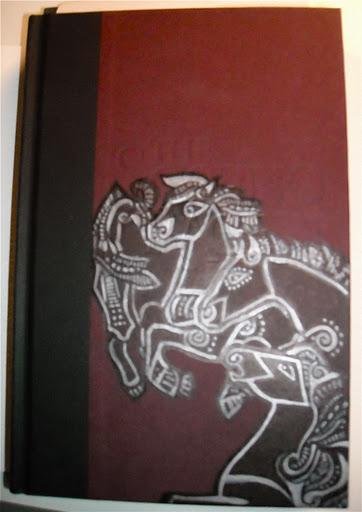
And guess what???  I won the big prize!!!  I won a copy of Scorpio Races with beautiful horses drawn on the cover by Maggie herself!  This is not only the first thing I’ve ever won, but by far the coolest thing I could ever possibly win.  I’ve admired Maggie’s artwork whenever she posts pictures on her blog.  Especially her Sharpie guitars, but as I have no use for a guitar, the book with her art was perfect!

I got the book signed by Maggie, told her I’d read all her books, told her I loved her blog, told her I appreciated the writing advice she posted because I was in an MFA program.  She was so personable and cheerful.  Book signings can be awkward sometimes, but there was none of that.  I give her top marks!

I can’t wait to read Scorpio Races, and will definitely post about it when I do!

Second bit of awesomeness: SCBWI Conference

I attended the SCBWI Fall Conference on Saturday.  For those of you who don’t know, it’s a writer’s conference sponsored by the Society of Children’s Book Writer’s and Illustrators.

There were 280 people in attendance!  We were packed into a ballroom in the Holiday Inn in Dulles for a day of speeches and advice regarding writing for children.

I’m not providing specific play by plays of the presentations because the material is copyrighted, but here is a brief rundown of the awesome day.

Author/Illustrator Brian Lies (Bats on the Beach, Bats in the Library, Bats at the Ballgame) spoke about marketing your book.  His presentation was magnificent and offered great ideas creating hype about your book and making a book signing more exciting.

There was an Agents Panel with Jennifer Rofe of Andrea Brown Literary Agency and Quinlan Lee of Adams Literary.  They gave lots of informative answers to questions about the writer/agent relationship.

Chelsea Eberly of Random House gave a talk about how to create the perfect “Hook for your Book” and how having a hook will both catch editors’ attention and help them sell your book.

The keynote speaker was author Han Nolan.  She was so sincere and inspiring.  What really resonated with me about her speech is striving for excellence when we’re writing, and reading the best books out there (award winners) so you know where the bar is set and to inspire you to reach for it.  Which is exactly what I’m doing by taking this course on Newbery books!  🙂

There was an author panel (Meg Medina, Anne Marie Pace, Wendy Shang, Amy Brecount White) about the highs and lows post-publication which offered a very realistic look at what it’s like to be a published author.

And finally, there was an Editor’s Panel on creating credible characters.  Chelsea Eberly (Random House), Caroline Abbey (Bloomsbury), and Abby Ranger (Disney-Hyperion) offered some constructive advice on common character flaws they see in writing and questions to ask yourself to create stronger characters.

This was a regional conference, meaning I didn’t have to travel far and it was relatively cheap (around $100).  The quality of information was excellent, and I came away feeling motivated and excited about writing and literature.  If you are a writer for children, I highly recommend you look into attending an SCBWI regional conference!

National Book Festival 2011

Here is my annual post on the DC National Book Festival!  Best FREE book event in the country!

Authors I saw speak (in order of appearance):

Sarah Dessen

Teen author, Sarah Dessen

I knew she was popular and has been writing for awhile, but I haven’t read anything by her.  I’ve never been a big reader of teen girl realistic fiction.  She was so charming that I downloaded one of her books on my Kindle while sitting in the audience.  She joked about how she was a very ordinary person and how when she came to events like this, she wanted to bottle up all the wonderful love and adoration from her fans.  Then, when she was home, doing laundry or dealing with crying children, she could be like, “See!  People think I’m amazing!”  She also jokingly said that she owes all her sales success to Mandy Moore.  Once Mandy Moore was on the cover of her movie edition, her books sold like hotcakes.  She joked that her family thanks Mandy Moore for everything in their house.  “We thank Mandy Moore for our refrigerator.”  One other cool thing that she does in her books that was a completely new concept to me, is instead of writing the sequels that her fans beg for, she has some of her characters from past books make guest appearances in new novels.  I thought this was such a cool idea!

Katherine Paterson and John Rocco

Illustrator Jon Rocco and author Katherine Paterson

Katherine Paterson is a living legend and John Rocco did the cover art for the Percy Jackson series.  The two of them teamed up to create a gorgeous book with 60 color illustrations.  The Flint Heart is a 1910 fantasy story by Eden Phillpotts retold by Paterson in more modern friendly language with more reader friendly pacing.  I bought this book after hearing them speak, and it is a gorgeous piece of book art!  Katherine Paterson and John Rocco were so cute together, as seen here in this picture:

Jack Gantos
Jack Gantos is quite a character.  Very lively, humorous, and full of outrageous stories.  I think several members of the audience were quite shocked to hear about how he went to jail for drug smuggling (I already knew this bit of back story).  I probably wouldn’t have chosen to bring it up at a national event in front of hundreds of people… but that’s just me.  Everything came with a dose of humor, and he got quite the round of applause.

Gordon Korman

Middle Grade author, Gordon Korman

Very cool guy.  One of the better speakers of the day.  And this guy’s book output is off the charts.  I loved how enthusiastic he was about the research process when writing books.  He said how research brings in some of the best plot ideas because sometimes the real stuff is too good for even the most creative brain to make up.  And he REALLY made me want to read all of the 39 Clues books.  The way they connect adventure to history and artifacts is too cool.  His advice to writers was to write about what makes you excited.  (I agree!)  Gordon Korman had one of the highest kid audiences of the day  🙂

Cassandra Clare
Cassandra Clare was probably the biggest disappointment for me of the weekend.  Her books are great fun if you are looking for an action-packed paranormal read with hints of romance.  I was hoping she’d be great fun, too.  She read from a script in a tired, flat voice that suggested she didn’t want to be there.  When teen girls flocked to the microphones for the Q&A portion and were showering her with praise… she didn’t seem grateful, and didn’t thank the readers for the compliments.  And then there was one off-color comment.  One girl asked if there was anything that was taken out of the books that Clare had wished had stayed in.  And Clare responded that there were several scenes detailing the villain, Valentine, killing masses of children.  And she thought that part was pretty cool and wished her editors hadn’t made her take it out.  Her editors didn’t think people would want to read about children being murdered.  I quite agree with her editors on this one.

Brian Selznick

Author and illustrator, Brian Selznick

Selznick was definitely one of the best speakers of the day.  I wouldn’t be surprised if his IQ is in the genius range.  He mostly spoke about how he’s trying to do new things with text and pictures through first Hugo Cabret and now with his new book Wonderstruck.  (You should run out and buy Wonderstruck.  It will win awards.)  He spoke of his love of museums and his love of E.L. Konigsburg, which inspired Wonderstruck.  His enthusiasm and innovation really shone through when he spoke about how and why he chose to tell two stories in Wonderstruck.  Two stories are interwoven from two different time periods in Wonderstruck; one story is told through pictures and one story is told through text.  But he thought about WHY a story would or should be told in just pictures and he was inspired by the deaf community who rely so heavily on images.  His speech really blew my mind and I wish it had been recorded (he requested no video recording).  A Hugo Cabret movie by Martin Scorsese is coming out this coming holiday season 2011, and Selznick said Scorsese was diligent in following the book and carried it around on set.  The trailer looks fantastic!

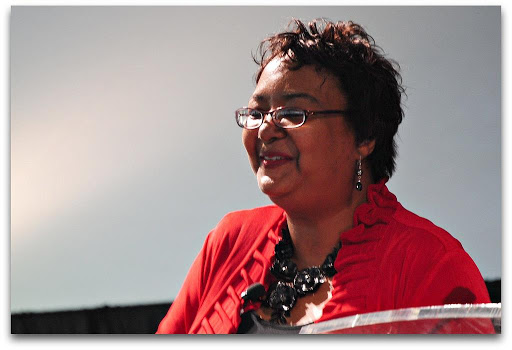
Rita Williams-Garcia
I was really looking forward to hearing Rita Williams-Garcia after reading One Crazy Summer this past weekend, and she did not disappoint!  (I was disappointed at the small crowd, but she was the last speaker of the day and many people were likely tired and hungry.)  Rita was so excited to be at the Book Festival speaking that she literally began by hopping up and down whilst giggling and grinning ear to ear.  She was so full of energy and absolutely adorable.  She said that one thing she loves about storytelling is you don’t need anything to tell a story.  Just your brain and your voice.  She described herself as a character driven writer (which doesn’t surprise me because her characters were so vivid in OCS).  She said she’s asking questions about her characters all the time and constantly thinking about them.  Rita believes that it’s the strengths and failings that make real characters.  She spoke about her own mother and how her mother wasn’t like other mothers (echoing themes from OCS), and did a hilarious impersonation of her bombshell mother walking into a concert at her school.  She was scared to write middle grade because she always wrote for teens.  And when asked about her writing process, she said she writes the moments of greatest impact first, and then fills in the rest.  I thought this was a really interesting method of writing, but it makes sense.  By writing critical scenes and seeing how your characters react, you get to know your characters on higher level, which would make writing the less crucial scenes easier having established your character’s inner workings.

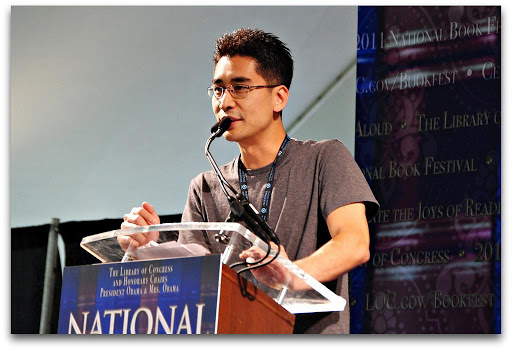
Kazu Kibuishi
This young Asian graphic novelist, creator of Scholastic’s Amulet graphic novels, was such a cool speaker.  I want to show his speech to my students.  He spoke of how difficult it was for him to figure out what he wanted to do for a living.  His parents wanted him to be a doctor.  He thought he wanted to be a writer.  He went to film school.  Was hired by Disney, left Disney.  He always denied his love of drawing.  He wanted to tell stories.  But when he finally discovered he could meld his love of storytelling with the love of drawing he’d been suppressing, he discovered his career as a graphic novelist.  I love seeing young, positive male role models for young people, and he definitely was one!

Graphic novelist, Kazu Kibuishi
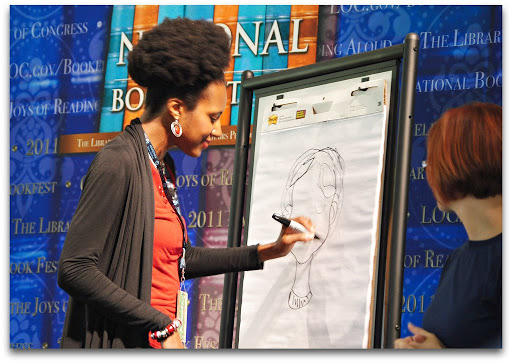
Kazu drawing characters from Amulet

Rachel Renee Russell
What I didn’t realize was that the Dork Diaries series (essentially the Wimpy Kid series but for girls) is done by a mother/daughter team.  Mom does the writing and daughter does the drawing.  The presentation was very cute and kid-friendly.  While mom talked, the daughter was drawing people in the audience in the cartoony style of the books.  Kids were so thrilled to see themselves drawn as cartoons.

Author, Rachel Renee Russell
Russell’s daughter, Nikki, drawing a member of the audience

As soon as the book festival was over, I started wondering who I would get to see next year!  Such a great experience!  I’m so lucky to live near DC!

Who do you hope to see next year?  My number one hope for next year’s festival: Scott Westerfeld.  Fingers crossed!

One Crazy Summer

Summary:
Delphine and her sisters, Vonetta and Fern, travel across the country to see the mother who abandoned them.  They don’t just find a mother during their four week trip, but also an understanding of their cultural identity.

Recommendation:

I absolutely loved this book.  In my opinion, this book deserved the Newbery Medal, not just a “Honor” title.  If you like books about mother/daughter relationships or historical fiction during the Civil Rights movement, definitely check this book out!


My Comments:
I agree with School Library Journal that this was an “emotionally challenging” book.  There are two threads that pull at reader’s heartstrings.  The first is the girls’ abandonment by their mother.  This thread is introduced to readers on page 4 when we learn of the young age these girls were left by their mother, “When Cecile left, Fern wasn’t on the bottle. Vonetta could walk but wanted to be picked up. I was four going on five.”  This instantly sets up sympathy and conflict.  It’s clear the girls have been without their mother but are now being sent to visit her for four weeks.  The author maintains this tension as Cecile remains cold and distant towards the children until the very end of the book.

The other emotionally challenging thread in this novel is the racial tension.  We are alerted to this racial tension very early on when Delphine thinks to herself, “The last thing Pa and Big Ma wanted to hear was how we made a grand Negro spectacle of ourselves thirty thousand feet up in the air around all these white people” (2).  This racial tension continues throughout the book.  The girls meet the Black Panthers, Delphine reads their news bulletins, and all three girls prepare for a rally.  The girls develop a growing awareness of racial tension and civil rights issues, but at the expense of their innocence.  The girls learn of the violence and unfairness that surrounds their race, and the author did this through the inclusion of true historical details such as the Black Panthers, jailed founder Huey Newton, and murdered Bobby Hutton.

Both School Library Journal and Booklist noted the strong voices and memorable characters of the three girls.  One of the scenes that I found most revealing of the three girls’ personalities is when Miss Patty Cake is ruined.  Vonetta’s insecurity and need for acceptance is revealed by her actions.  Her shame at Crazy Kelvin’s comment and desire to be accepted by the Ankton girls causes Vonetta do something hurtful to her own sister.  Delphine’s character is revealed in how she attempts to remedy the situation, “I grabbed Miss Patty Cake’s dimpled arms and chubby legs. I went after her cheeks and forehead. I scrubbed every blacked-up piece of plastic, wearing down that Ivory bar from a nearly full cake to nearly half flat. I scrubbed and scrubbed until my knuckles ached” (95-96).  Delphine is again acting like a mother figure, trying to protect and remedy Fern’s broken heart.  Fern reveals her innocence and need for love in how she carries Miss Patty Cake everywhere, but after the incident, we see a new maturity in Fern.  She does not whimper or pout the next day when Miss Patty Cake is gone, but instead, “Fern no longer looked for her doll when we left Cecile’s for breakfast” (97).  The author never said Fern’s heart was broken over the loss of her doll, but you knew it.  The author let actions speak for themselves, and in Fern’s case, actions prompted growth in character.  I really fell in love with these girls during this book, and I think that speaks for their excellent characterization.

Kirkus Reviews said that this story is told with “writing that snaps off the page.”  I completely agree.  There were so many memorable lines that had Delphine’s distinct voice.  A voice that was sharp but metaphoric.  Delphine describes what mother means to her in the beginning of the book,

“Mother is a statement of fact. Cecile Johnson gave birth to us. We came out of Cecile Johnson. In the animal kingdom that makes her our mother. Every mammal on the planet has a mother, dead or alive. Ran off or stayed put. Cecile Johnson—mammal birth giver, alive, an abandoner—is our mother. A statement of fact” (14).  

Delphine uses simple, direct language, and yet by comparing her mother to a mammal in the animal kingdom, she reveals so much about her feelings towards her mother.  Another line I loved and that reveals Delphine’s voice was, “We all have our la-la-la song. The thing we do when the world isn’t singing a nice tune to us. We sing our own nice tune to drown out ugly” (90).  This demonstrates the sharp yet metaphoric quality of the writing.  This statement uses short, simple words: nice, tune, ugly.  But Delphine is making a deep comparison between music and life.