Initial Thoughts on Meatloaf

Clever and original concept. Kids will love looking though this scrapbook style collection of notes and objects to figure out the story. 

However, I think the format of the book causes the book to become dated VERY, VERY quickly. The IM chat screens looked ancient. The pop culture references via magazines and the interests of the girl also made the book feel dated. Example: The girl wants to be the Sugar Plum Fairy in a ballet production. Comes off as very cliche and traditional. What about soccer, basketball, lacrosse, volleyball, or one of the many sports the modern girl participates in? 

I don’t know how to do a book like this and keep it timeless. It would be a serious challenge. 

I’d also like to see this concept applied with cultural diversity in mind. Meatloaf and ballerinas and science fair projects… screams white suburbia. 

The graphic layout/style would really appeal to English Language Learners and lower socioeconomic kids.

Initial Thoughts on Nomansland

I was so optimistic about this book that I chose to read it first.  Reviews compared it to The Giver.  The cover reminded me of Katniss in Hunger Games.  But sadly this book did not live up to either for me.

What the book is about:
In a future world, some sort of nuclear disaster has caused worldwide destruction and poverty.  Most people are left mutated by the radiation and struggling to survive.  There is an island of all women who are untainted by radiation and guard their island against the outside world.  The girls live by a strict code of rules and have no memories of how the world used to be.  They fear men and the mutants.


Why I think my professor chose this book:
I’m trying to think like my professor and analyze why tis book would be a good representation of sci-fi YA (particularly sci-fi that looks at gender).  This book is designed to promote feminist discussion.  It’s the major theme of the book: feminism.  That’s one reason why I think he chose it.  Another possible reason (and one of the only things I found interesting) was how the future people in the book described objects from the past.  Example: A large flat screen TV mystified the girls as there was no electricity, and they did not know what it did.  So they described it as a gray glass window that does not show you the view outside.  These descriptions were interesting because the reader would be trying to guess what object was being described, and from a sci-fi writer’s viewpoint you wonder how you would attempt to describe unknown objects from the past.

Why I did not particularly like the book:
The book was very dark and depressing.  Suicide, drugs, murder.  Not what I normally choose to read.  I like my dystopian lit books, but I still want to be rooting for my main character.  I still want the dystopian world to be intriguing.  I found the setting to be desolate and dull.  I felt no connection with Keller.  I did not find this to be a page turner at all.  There were some strange passages that described nipples and nudity.  And I really would never recommend this book to a teen I teach.  I would feel uncomfortable doing so because of the subject matter in the book (drugs, nudity, suicide, murder, anti-Christianity, rape).  I’d imagine many adults would feel similarly, and that will make this book a hard sell to school and libraries.  The only similarity to The Giver is that the book is about a strict dystopian society and written in unflowery, simple prose.  Perhaps Keller is a little like Katniss in that they both make tough decisions, are forced into roles they don’t want, and show leadership qualities.  But I didn’t care much about Keller.  I did care about Katniss.

What I wish this book had delved deeper into:
The relationships between the “pure” women who have been unaffected by radiation and the outside world.  More discovery about the mutant men who visit the island.  More about Ms. Windsor, her leadership, and the state of her people.  More about the disaster that created this world.

Back in Business

I’m blogging again as grad school is right around the corner!  Below are the three courses I’m taking, their descriptions, and the book lists.  Let me know if you’ve read any of the books I’m going to be reading!

Genre Study: Forms and Boundaries 
We will look at traditional forms of writing for young readers as launching points for genres that bend the boundaries and create new ones like novels in verse, graphic novels, intertextual writing, and metafiction, among others.  This course can be taking as a creative or critical credit and focuses on the study of the craft of writing through close reading and analysis and practicing what you learn through writing.
Text list:
Clare, Cassandra. Clockwork Angel
Fleischman, Paul. Genre bending text of your choice. 
Grimes, Nikki. Dark Sons
Hesse, Karen. Witness
Holm, Jennifer and Mathew. Baby Mouse: Queen of the World
Holm, Jennifer. Middle School is Worse Than Meatloaf
Hopkins, Ellen. Impulse
Macaulay, David. Black and White
Muth, Jon. Zen Shorts
Parker, Toni Trent. Sienna’s Scapbook: Our African American Heritage Trip.
Yang, Gene Luen. American Born Chinese


Genre Study: Fantasy
Realism is easy.  Fantasy is hard. 
You have to make an imaginary world feel, sound, look, and smell real.  You have to create supernatural creatures and magic systems and even societies that don’t distract your reader from the story you’re telling.  You have to do all that, and you still have to pay attention to the other things that go into all good fiction, like psychologically convincing characters, a compelling plot, narrative tension, an informing theme, and a personal voice.
In this course, we will focus on the issues of craft that are particularly important to the writing of fantasy:  exposition, world-building, and internal logic.  We’ll be doing close readings of three novels that exemplify three very different approaches to these problems. We’ll explore how to generate ideas for stories and plot-lines with prompts and exercises.  And we’ll write and critique drafts of between 2 and 4 fantasy short stories.

Text list:

Black, Holly. Tithe
Eager, Edward.  Half Magic
Pratchett, Terry. The Wee Free Men

Young Adult Science Fiction

We will examine of the history and development of technological literature (1910-1947) and science fiction (1947-present) written and marketed expressly for the young adult reader.  The seminar will also address variety of relevant topics: science fiction and literary theory, series books for young readers, science fiction and technology, gender in/and science fiction, science fiction and American cultural history and development.  Discussion will begin with the Tom Swift series (and others) from the first half of the twentieth century, move through such mid-century authors as Robert A. Heinlein, Isaac Asimov, and André Norton, and conclude with writers like Robert C. O’Brien, Monica Hughes, William Sleator, and Louise Lawrence.  Major critical works will include: Trillion Year Spree (Aldiss), Robert A. Heinlein: America as Science Fiction (Franklin), Back in the Space Ship Again (Sands and Frank), Science Fiction for Young Readers (Sullivan, ed.), and Young Adult Science Fiction (Sullivan, ed.).

Text list:
Appleton, Victor. Tom Swift and His Motorcycle
Burroughs, Edgar Rice. A Princess of Mars
Christopher, John. The White Mountains
Collina, Suzanne. The Hunger Games
Hauge, Leslie. Nomansland
Heinlein, Robert A. Rocket Ship Galileo 
Heinlein, Robert A. Have Space Suit–Will Travel
Hoover, H. M. Orvis
Hughes, Monica. Keeper of the Isis Light
Lawrence, Louise. Dreamweaver
L’Engle, Madeleine. A Wrinkle in Time
Norton, Andre. Time Traders
Sleator, William. Interstellar Pig
Smith, E. E. Skylark of Space

Last Class

Today I had my last Craft of Writing class, and tomorrow I have my last History and Crit class. Today was the more sad of the two days because I looooove my Craft of Writing class and I looooove my professor. I wish I could take this same exact group of people and just continue the class next summer. We took our teacher out to lunch after class, and I also bought a card for everyone to sign. We all want to keep in touch with her.

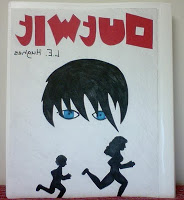
Today, our last assignment, was to create a final product that we would call our “Masterpiece.” It was essentially supposed to be a final copy of the first chapter of the book we’ve been working on for the last 6 weeks. We were also supposed to include the working title, book cover (which I drew myself!), book jacket blurb, a pretend “About the Author” and pretend praise for the book. Here is my cover (though it is a mirror image and I can’t figure out how to flip it. And then below is my pretend jacket blurb etc. Enjoy this glimpse of what I’ve been working on!
Being smart isn’t a good thing.

Getting the right answers on a test can get you killed.

The world doesn’t need smart people. We have computers now.
When her parents are killed for being too intelligent, Idalis knows it’s only a matter of time before she and her younger brother, Liam, meet the same fate. Idalis’ world is full of secrecy, violence, and deception. Can she survive? Is there anyone out there to trust?
About the Author
________ Hughes grew up in *********, just outside of our nation’s capital. She is very close with her two brothers, ______ and ______.  She received her Masters in Children’s Literature at ******* University. She was also a middle school teacher for ten years. Her favorite authors are Lois Lowry and J.K. Rowling, and she loves reading all genres of fiction. She also enjoys playing volleyball and being outside. Outwit is her first novel.
Praise for Outwit
“Hughes’ first novel deserves an A+ for taking its readers through a life and death question of what – and who – is really important. Sensitivity and science fiction walk hand in hand throughout her pages.” – Author, Nancy Ruth Patterson
Outwit has a setting that is both eerie and familiar despite being set far in the future. The allusions to the Underground Railroad and prejudices in our past blend seamlessly with the story and give this science fiction novel a grounding realism. The thought-provoking and serious issues raised in this book will stay with you long after you turn the last page. Great things can be expected from this first-time novelist.” –Booklist (note: This is PRETEND praise. Not Real!)

Critique Day

Sooooo… Today we had a critique day, where we brought in 3 copies of our first chapter in it’s most final form. We got into groups of 4 and took turns reading people’s work and giving feedback.

I just got finished reading through what my peers wrote(which wasn’t much), and… how do I put this? My friend, “S” gave me the best feedback. She posed questions I hadn’t considered, and pointed out exact places to elaborate. The other two people’s feedback wasn’t quite as useful. One kept suggesting I cut out words that would have turned a lot of my sentences into fragments, but then again my criticism for her was that she overused sentence fragments. And she recommended I change the order of some parts, but I don’t understand the reasoning behind some of the moves. Then the other guy is adorable, but didn’t write much. Though he made a couple of good formatting suggestions.
And now I feel kind of bad because I pretty much bled ink on their paper. I didn’t leave a space unmarked. And I don’t know if their self-esteem is ready to see that on their work…
Especially as a teacher and having lots of practice grading, this is something I’m used to doing. And I don’t think the others in my group were. But in addition to that, this class has made me really analytical of writing, and I read differently now than I used to. So I really saw today, for the first time, that I have the potential to be a book editor. My teacher even told me individually that she thought I’d make an excellent book editor. Pretty cool. It’s like another career path has opened up before me that doesn’t look too shabby.
My teacher was absolutely adorable and bought ALL of us a copy of one of her books and autographed them for us. Then she also wrote a pretend review blurb for our books.
I don’t have my blurb with me at the moment, but it was really sweet and she said something about my book “blending sentimentality and science fiction seamlessly.” I may not have the wording right but it was something like that.
I’m exhausted because I’ve been staying up until the wee hours of the night and then not sleeping terribly well. But I’ll be home in 4 days, where I will surely catch up on sleep in my own beautiful bed. Until then, I’ll be proofreading and revising papers…

Tight Writing

I’ve been really happy with this sci-fi book I’ve been writing. As you can probably tell from past posts. After speaking with my teacher on Wednesday, I worked out possible solutions to issues I was having.

One issue I was having was whether or not to have a villain. The book is primarily about survival in a hostile environment. But my teacher proposed the question of how did the world get this way, and I decided that I did in fact need a villain.
So I spent all of Wednesday night creating two villains. And I’m extremely happy with the results. There will be lots of deception/twists. Things won’t be as they appear. And my villains will juxtapose nicely with my main character.
So today, I spent a good four hours in the library doing something I’ve NEVER done before. I took every scene I’d written so far, and completely mixed them around and re-ordered them. I created a new outline, moved things around, cut things, and wrote new stuff to fill in the seams. The result is even better than I imagined. It almost feels like I didn’t write it because I couldn’t possibly have made things fit together that way.
I’m just thinking back to how I wrote before this summer… Not that it was bad, just not as deep. Not as complex. I couldn’t have written this story. This story is so tight, and everything I’ve written before seems loose by comparison.
I wish I could post more details about the story, but I can’t if I want it to be published. But if anyone wants to be a test reader later on in the process, let me know 😉

Eco-Criticism

We’ve been doing presentations each class, and the girl who went today was probably my favorite presentation so far. There is a new brand of literary criticism that analyzes books for how the present environmental issues. Especially in children’s literature, the criticism looks at the didactic nature of a book and how a book teaches a child about the human/nature relationship.

She used eco-criticism on the last book in the Atherton series, The Dark Planet, which I haven’t read, but still really enjoyed listening to her analysis. She said that while Carman did a good job of showing that in order for humans to lead a healthy happy life, they need a clean environment to live in (correspondingly if you have a filthy, uncared for environment you will live a correspondingly sickly, unhappy life), Carman also failed at conveying a key message. In the book, The Dark Planet (a polluted and overcrowded planet that brings out disease in it’s inhabitants) is miraculously cleaned up with crystals that are suddenly found and released. This is not sending a good message to our youth because it’s essentially advocating complacency and instilling the idea that miraculous technology will eventually come along to clean up our messes.
I also liked the point she made in her presentation about the lack of species diversity on the utopian satellite planet. In their utopian world, there are only horses, sheep, rabbits, and a handful of genetically engineered creatures/plants. There are no fish, birds, or insects. What does this say to our youth about protecting endangered species?
Really fun presentation to listen to. I did not get bored once. Then we talked about folktales… where I did get bored. I just wanted to get out so I could work on my writing, which I’m going to do as soon as I finish this post!
Only 4 more classes!!!

Coming Together

Seeing a book come together from nothing over the past 5 weeks is pretty fantastic. I had 3 other works-in-progress when I arrived at grad school, but none of which are as complex and ambitious as what I have before me now. Seeing the themes and richness in this idea really shows how far I’ve come and how much my graduate classes has given me.

One of the speakers we had at the beginning of the 6 weeks was asked the question, “Could you have done what you’ve done without going through an MFA program? (MFA = Masters in Fine Arts) He answered wholeheartedly “No.” He said he grew so much while pursuing his masters here, and he would never have been published if he hadn’t gone through an MFA program.
I don’t think it’s so much that the teachers are showing me how to create a character, or how to outline a plot. You have to do that on your own, and there isn’t any magic formula. What the program is doing for me is exposing me to literature I probably wouldn’t have read on my own, teaching me how to read like a writer, and making me question the words I put on a page. I think I’m developing more of the mentality of a writer by being immersed in it.
Writing isn’t just telling a story and loving your characters. That’s all well and good, but there is a great deal more to think about. I honestly believe that by the end of this I will have a novel I can be proud of, with more layers to it than I would have written on my own. And maybe I’ll earn a little respect and success in the publishing world too… dreaming big 🙂

"The Others"

Today in class we looked at both The Outsiders and Harriet the Spy as novels about outcasts or as my professor kept referring to “the others.” (I kept thinking of Lost.) He meant the not-quite-perfect children. Kids on the outside of the social circle.

It was an interesting approach. We talked about how the greasers in The Outsiders really aren’t at the bottom of the food chain socially. In the book there is mention of the hoods, which are at the bottom because they are described as the more uneducated bunch. Ponyboy, his brothers, and the rest of the greasers are actually more of the middle class. If it weren’t for their parent’s death, Darry could have gone on to college on an athletic scholarship. Ponyboy is smart and gets good grades. They have more potential than the hoods, and that’s probably why the Socs see them as more of a threat. Because there is the possibility that Ponyboy and his brothers might one day be their equals.
I decided I’m not such a fan of Harriet the Spy. Here’s why: Harriet does not learn anything after people find her journal and read it. She writes down such mean and horrible things. She’s sees it as the truth, and so there’s nothing wrong. She writes things like:
PINKY WHITEHEAD WILL NEVER CHANGE. DOES HIS MOTHER HATE HIM? IF I HAD HIM I’D HATE HIM.

IF MARION HAWTHORNE DOESN’T WATCH OUT SHE’S GOING TO GROW UP INTO A LADY HITLER.


That isn’t the TRUTH. That’s just plain mean! And by the end of the book, she doesn’t develop any sort of heart or compassion. She simply says, “Ole Golly was right. Sometimes you have to lie.” The lesson she learns from the whole book is that you have to lie to have friends. That’s a terrible lesson to learn.
I had a very hard time liking Harriet at all reading this as an adult. I think as a kid, I thought she was shocking. I probably thought it was cool she had a secret notebook. But she’s a mean kid.
After class tomorrow, I meeting with my teacher to discuss my novel. I made a two page list of road blocks I’ve encountered. Maybe she can help me brainstorm ways around them.

7 more classes…!

I will be done with classes next Thursday, and I have a lot to do before then. A 2500 word term paper that will involve lots of researching and analysis and a Masterpiece/Book Jacket to create. I really, really, really miss home. And I really, really want to go to the beach because it just doesn’t feel like summer until I’ve been to the beach. I normally head to Bethany the week after school lets out in June, and not getting there until August has left me craving sand and sunscreen. Maybe we won’t get so much snow next year and I can squeeze in a weekend before I leave for Roanoke next summer. We’ll see.

I’ve e-mailed my professor for his opinion on my term paper, but I think I’m going to do a feminist analysis of The Country Bunny with the Little Gold Shoes and look at how that picture book portrayed women. I’m sick of Marxism, and I want to stay away from that approach…
The Masterpiece is essentially to polish up the sci-fi dystopian project I’ve been working on. Then I need to create a book jacket which includes the cover art and jacket summary, etc. That should be fun. It just might be tricky to polish this thing up because there are still some things about the future setting that I’m not sure about and still working out.
I did a presentation today on Children’s book series, which I had a lot of fun preparing for. It was only supposed to be a 20 minute presentation, I went over by 10 minutes, and I rushed and left out a TON of stuff I could have and wanted to say. I could easily have spoken for an hour. It was a little disheartening that I didn’t get to everything. Oh well. My teacher liked it. She said when I was done, “I’m not even going to ask you how long that presentation took to make.”
This time has definitely gone by fast. I will most of all miss the Library and my Craft of Writing class (mostly the teacher). But boy! I can’t wait to come home!