One Crazy Summer

Summary:
Delphine and her sisters, Vonetta and Fern, travel across the country to see the mother who abandoned them.  They don’t just find a mother during their four week trip, but also an understanding of their cultural identity.

Recommendation:

I absolutely loved this book.  In my opinion, this book deserved the Newbery Medal, not just a “Honor” title.  If you like books about mother/daughter relationships or historical fiction during the Civil Rights movement, definitely check this book out!


My Comments:
I agree with School Library Journal that this was an “emotionally challenging” book.  There are two threads that pull at reader’s heartstrings.  The first is the girls’ abandonment by their mother.  This thread is introduced to readers on page 4 when we learn of the young age these girls were left by their mother, “When Cecile left, Fern wasn’t on the bottle. Vonetta could walk but wanted to be picked up. I was four going on five.”  This instantly sets up sympathy and conflict.  It’s clear the girls have been without their mother but are now being sent to visit her for four weeks.  The author maintains this tension as Cecile remains cold and distant towards the children until the very end of the book.

The other emotionally challenging thread in this novel is the racial tension.  We are alerted to this racial tension very early on when Delphine thinks to herself, “The last thing Pa and Big Ma wanted to hear was how we made a grand Negro spectacle of ourselves thirty thousand feet up in the air around all these white people” (2).  This racial tension continues throughout the book.  The girls meet the Black Panthers, Delphine reads their news bulletins, and all three girls prepare for a rally.  The girls develop a growing awareness of racial tension and civil rights issues, but at the expense of their innocence.  The girls learn of the violence and unfairness that surrounds their race, and the author did this through the inclusion of true historical details such as the Black Panthers, jailed founder Huey Newton, and murdered Bobby Hutton.

Both School Library Journal and Booklist noted the strong voices and memorable characters of the three girls.  One of the scenes that I found most revealing of the three girls’ personalities is when Miss Patty Cake is ruined.  Vonetta’s insecurity and need for acceptance is revealed by her actions.  Her shame at Crazy Kelvin’s comment and desire to be accepted by the Ankton girls causes Vonetta do something hurtful to her own sister.  Delphine’s character is revealed in how she attempts to remedy the situation, “I grabbed Miss Patty Cake’s dimpled arms and chubby legs. I went after her cheeks and forehead. I scrubbed every blacked-up piece of plastic, wearing down that Ivory bar from a nearly full cake to nearly half flat. I scrubbed and scrubbed until my knuckles ached” (95-96).  Delphine is again acting like a mother figure, trying to protect and remedy Fern’s broken heart.  Fern reveals her innocence and need for love in how she carries Miss Patty Cake everywhere, but after the incident, we see a new maturity in Fern.  She does not whimper or pout the next day when Miss Patty Cake is gone, but instead, “Fern no longer looked for her doll when we left Cecile’s for breakfast” (97).  The author never said Fern’s heart was broken over the loss of her doll, but you knew it.  The author let actions speak for themselves, and in Fern’s case, actions prompted growth in character.  I really fell in love with these girls during this book, and I think that speaks for their excellent characterization.

Kirkus Reviews said that this story is told with “writing that snaps off the page.”  I completely agree.  There were so many memorable lines that had Delphine’s distinct voice.  A voice that was sharp but metaphoric.  Delphine describes what mother means to her in the beginning of the book,

“Mother is a statement of fact. Cecile Johnson gave birth to us. We came out of Cecile Johnson. In the animal kingdom that makes her our mother. Every mammal on the planet has a mother, dead or alive. Ran off or stayed put. Cecile Johnson—mammal birth giver, alive, an abandoner—is our mother. A statement of fact” (14).  

Delphine uses simple, direct language, and yet by comparing her mother to a mammal in the animal kingdom, she reveals so much about her feelings towards her mother.  Another line I loved and that reveals Delphine’s voice was, “We all have our la-la-la song. The thing we do when the world isn’t singing a nice tune to us. We sing our own nice tune to drown out ugly” (90).  This demonstrates the sharp yet metaphoric quality of the writing.  This statement uses short, simple words: nice, tune, ugly.  But Delphine is making a deep comparison between music and life.

Thoughts on Moon Over Manifest

2011 Newbery Winner
Summary: 
Abilene Tucker is left by her father in the town of Manifest with no knowledge of if or when he will return to her.  Abilene begins what will be her summer mission: finding clues of her father’s past in the small town of Manifest. 


Merits of Moon Over Manifest
I agree with School Library Journal that “history and fiction marry beautifully” and that the story’s plots are “artfully intertwined.”  Similarly stated, the BCCB wrote that the book was “ingeniously plotted and gracefully told.”  The melding of two different time periods through multiple medias while maintaining flow and clarity is one of the standout features of this novel.  Two years, 1918 and 1936, are woven together to create one cohesive plot strand.  Abilene Tucker hears the story of Ned and Jinx through a variety of modes.  She learns their story through Miss Sadie’s flashbacks, Hattie Mae’s News Auxiliary’s, and Ned’s letters.  The book’s presentation contributed to the clarity of these story forms.  Different fonts and page layouts aided the reader in their comprehension.  To use so many forms and still keep the story organized and clear was quite impressive.
I also agree with Booklist that the story had “believable dialogue, vocabulary and imagery appropriate to time and place.”  Historical novels present quite a challenge.  Authors must spend a significant amount of time doing research, but then it is up to the author in how that research is used to its best advantage in the story.  Vanderpool used many key details from the time period for both accuracy and plot development.  Small details such as food (Shady’s burnt biscuits or Lettie’s ginger snaps) helped create an authentic historical environment, while researched details such as Spanish influenza and immigration provided inspiration for key plot points.
I agree with Kirkus Reviews that the novel had a “deeply gratifying ending.”  I’ll admit that I found this book slow moving at first, but there were so many threads and unsolved mysteries that the reader had to keep moving towards a hopefully gratifying ending.  The revealing of both Gideon’s identity and Gideon’s motive for leaving Abilene really framed the whole story nicely.  Miss Sadie’s story was equally moving and paired well with Gideon’s past, strengthening themes of the power of a parent’s love and the pain of separation.  The interconnectedness of all the plots and subplots left the reader feeling immensely satisfied.
I also believe that one of the major merits of this book was stated by Publishers Weekly: “insight into family and community.”  We witnessed firsthand the sadness that comes from a family’s separation through Gideon/Abilene, but we also witnessed the sadness that comes from a community that has fallen apart.  Manifest had lost its vibrancy and life, but we witness a rebirth as Abilene fosters communication and hope in the community.  This is a unique theme that empowers children by showing them the role they can have in their own community.  This theme was also echoed in Jinx’s story when he is able to save the community through his con tricks.  I loved this message of empowering children in their communities and that even children can make a difference.
Things I Wasn’t so “Over the Moon” About:
One issue that was never resolved is the issue of Abilene’s mother.  Supposedly she is in hiding, but her identity or reason for disappearance is never resolved.  At one point in the story, I thought that Gideon’s reason for leaving was to find Abilene’s mother because Gideon realized that Abilene was becoming a young lady and would need her mother.  But perhaps Gideon didn’t want Abilene along for the journey in case the mother wasn’t “alright.”
The large cast of secondary characters were a challenge to keep straight despite the nifty cast of characters in the book’s beginning.  While Vanderpool’s motivation was probably to create a true community within her text and to show the passing of generations, I wonder if some weeding would have been beneficiary.  I was taken out of the story due to confusion over a character on more than one occasion.
P.S.
I heard Clare Vanderpool speak at the 2011 Gaithersburg Book Festival  🙂
I hadn’t read the book at the time, so I don’t remember much in the way of plot details.  But she spoke about how the Newbery had changed her life, the impact on her family, how her kids had been supportive, how she had the opportunity to travel, and what it was like to get “the call.”

Moon Over Manifest and Typewriters

Boo.  No writing was done today.  Instead I read over 70 pages of Moon Over Manifest of which I have an assignment due Monday at 9am for my online class.

Here’s a favorite quote so far:

“The Manifest Herald newspaper office was about centered on Main Street and we walked into a holy mess.  Newspapers were stacked two and three feet tall.  A typewriter sat on a cluttered desk, its keys splayed open with some scattered on the desk like it tried to spell explosion and the explosion happened.”  (Page 14)

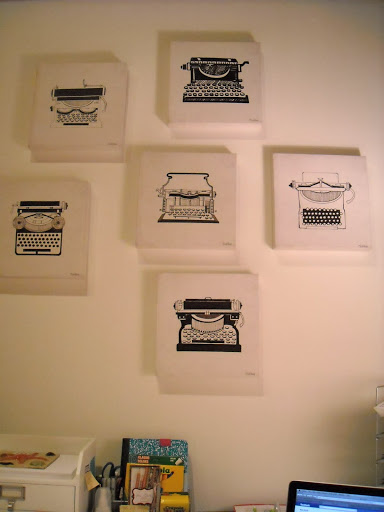
I sort of have a romantic thing for typewriters.  As you can see by the prints over my desk.


I’ve never typed on one.  I recently saw a gorgeous, black, very antique-looking and relatively small typewriter for sale at a vintage store by me for $95 and was very tempted to purchase it.  As decoration?  I don’t even know.  But it’s driving me crazy that I could go back and it won’t be there.

I need to read 70 pages a day in order to finish MoM by Saturday night.  Wish me luck!

Got in to Pottermore!

J.K. Rowling is doing a week long trivia contest where the prize is early access to her Pottermore web experience.  Each day a clue pops up for a limited time (usually around 30-45 minutes or however long it takes for 140,000 people to register).

First day = 1st Book / Sorcerer’s Stone
Second Day = 2nd Book / Chamber of Secrets
Third Day = 3rd Book / Prisoner of Azkaban
And so on…

I went to bed with my laptop beside me so that I could check if the clue was up without getting out of bed.  The first clue was at 4am (obviously missed that one) and the second was already closed yesterday when I woke up at 8am.

I woke up at 6:27 this morning, hit refresh on the Pottermore website, and BAM!  Day 3 clue was up and not filled!

The question was:

In the Gryffindor versus Slytherin Quidditch match, in Harry’s third year, how many points is Gryffindor leading by before Harry catches the Golden Snitch? Multiply this number by 35.

The answer was: 2100

It took you to the website of the UK Guardian, and an article about Pottermore.  Up in the top right corner was an ad box with the Magical Quill.  You had to wave your mouse beneath the quill to make it levitate and then click on it.

You then filled in all your user information, chose a username from a list of five choices, and set up a password and e-mail.  There was a cute little bit where there they show your name in a book as a “Magical Person” along with the recognizable Potter characters.

I got my brother in, too!  So exciting!

My confirmation e-mail came about an hour after I registered.  Woo hoo!

The whole experience feels very much like Charlie and the Chocolate Factory and the search for a golden ticket.

So fun!  J.K. Rowling, I love you.  🙂

Borders Closing and Tips from an Agent

If you haven’t heard, Borders will be liquidating and closing all its stores.  The filed for bankruptcy earlier this year and after no bids (…or bailouts *cough* *cough*) they are going under.

This is TERRIBLE, and let me tell you why:
Borders was the 2nd largest book retailer in the U.S. and has left Barnes and Noble with an overwhelming monopoly.  I’ve never been as big a fan of B&N.  They have more limited seating in coffee areas, and their coffee is more expensive.  (At Borders, I earned free coffees too!) Depending on the store, I have also found they often have a more limited selection of certain genres (Their graphic novel section is pathetic–just one skinny bookshelf).  And now the purchasers of books at B&N will control what titles you see on shelves.  You can’t go to another store to see if there is a different selection of books.
This is going to take a huge hit on the publishing industry.  All of a sudden there are 400 stores not selling books.  There are 400 stores not promoting books.  There are 400 fewer stores to do book events and signings.  This is going to HURT.  I don’t even know what the implications could be in the next few years.
There will be 11,000 people losing their jobs.  This is also 11,000 people whose job it was to read books and recommend books.  We are losing a big chunk of the population who promoted book sales.
And while this could be very good business for Barnes and Noble, it could very well be the beginning of their death as well.  People could become frustrated by the lack of availability of books in stores and turn to eBooks and online more so than ever before.  If people see this as the direction things are going anyway, then why fight it anymore.  Borders closing may be the push people needed in hopping on the eBook bandwagon.
The whole thing frustrates me.  I love my Kindle too, but I don’t want to see brick and mortar bookstores disappear.  I still make an effort to buy books in stores, especially my favorites, or books as gifts, or books for my classroom.
If bookstores are going to survive, they are going to have to take a new approach.  If I were in charge of revamping the bookstore industry, here’s what I would do:

-Hire event planners.
-Hold events and workshops. 
(Some free, some not.  I have a plan of attack ideas there, too.)
-Plan events and workshops that pair well with books.
-Sell those books.

Get people back in the stores by doing things that online or eBooks CAN’T DO.  Socialize, food and drink, hands-on opportunities.

If anyone would like to hire me to plan book related events, I am willing and able.  I could plan book events that would rock the industry’s world.
Speaking of the book industry, literary agent Quinlan Lee came to speak to our grad program on Monday night.  Here’s some of what she shared with us:
What an Agent Does:
  1. Support our clients
  2. Help manage your career
  3. Negotiate your rights
  4. Be your advocate
She spoke about how her job is much like that of a real estate agent.  People are hunting for the perfect house.  Publishers are hunting for the perfect book.  People have spent years building, remodeling, living in, and loving their home.  Writers have spent years writing, revising and loving their manuscript.  A real estate agent knows the housing market and matched buyers up with sellers based on what each is looking for.  A literary agent does the same thing.  They know the publishing industry and match up publishers and writers based on what they are looking for.
An agent also makes sure that you are treated fairly by publishers and plays bad cop when necessary.  You want your publisher/editor to love you.  So let the agent do the fighting dirty work for you so that a publisher still wants to buy your books and work with you in the future.
She advised to have confidence because editors need you.  They need people to write great stories.
Her tip for a dream manuscript is the 5 page rule.  You have to make the reader want to know what is going to happen next in the first five pages.  Hooking them in the first page is even better.
What they are looking for in a manuscript:
  • it’s timeless
  • award winner potential
  • timely
  • action driven
  • suspenseful
  • high concept
  • fun
  • page turning
  • thought provoking
  • fresh theme
She also said all the publishers are asking for “Boy Middle Grade.”  Funny, action-packed, pre-teen books.  (Like Wimpy Kid, Percy Jackson, Capt. Underpants)
Overall, I thought she was very encouraging and realistic.
Time to get writing!

Thoughts on Harry Potter and the Deathly Hallows Pt 2

Spoiler Alert!
Seriously don’t read if you haven’t seen the movie or don’t want to know what happens, etc.

I used to be quite fanatical when it came to Harry Potter.  Like obsessive.  My brothers will attest to it (and they don’t even know all of it).

I’ve since calmed down.  Become more normal.  Grown up.  I can now go whole weeks without thinking about HP or connecting something in daily life to HP.  I’ve diversified my interests.

But I still deeply love Harry Potter and J.K. Rowling.  The only thing that may surpass my love for HP someday is giving birth to my own children.  You may think I’m exaggerating and being melodramatic, but I’m really not.

So it was really, really hard for me to not go to the last midnight premiere.  And it didn’t help hearing people talk about it in class all day Thursday.  But I waited until Saturday when my mom and brother came to visit.  Me and my brother, who I will refer to as Pacman, have been through many midnight releases together.  We have lots of fond memories of eating jelly beans and talking to costumed people.  My mom went to midnight parties to get the books for us when either we were too young to stay up so late or when I had to work the next day.  They’ve both been through this HP craze with me, and I’m really glad we waited to see it together.

They brought costumes, and we dressed up…  No one else was dressed up when we went to the theater… Because the movie had no been out for 2 days and all the crazies had already gone.  But we looked cool.

I’m glad I waited to see the movie with them.  It was more meaningful and I loved experiencing it together.  We had so much fun dissecting the movie afterward and talking about our favorite parts.

My favorite part of the whole movie was any scene with Maggie Smith/McGonagall.  I didn’t expect to love her parts so much, but she really stole the movie for me.

The Gringotts scenes were EXCELLENT.  So impressed with that part of the movie.  The preparation of the castle for battle was awesome as well.

The parts that were a bit of a let down for me were:

  • Molly Weasley’s BIG line
  • Neville’s killing of the snake
  • the battle post-Harry’s death
Why these parts weren’t so great:
There was no lead up to Mrs. Weasley’s line.  I didn’t even know Bellatrix and Ginny were battling.  They barely even show Ginny’s face.  Without that build-up of Ginny being targeted by Bellatrix, the line didn’t pack quite the same punch.  Though Mrs. Weasley is still AWESOME.
I thought Neville killed the snake in front of EVERYONE.  Harry was faking dead, and Neville was standing up to Voldemort.  Harry disappears under the invisibility cloak, Neville kills the snake with the sword of Gryffindor, Voldemort freaks out, but invisible Harry starts shooting out protective spells to protect everyone from Voldemort’s fury.  The movie didn’t do it that way.  Harry was visible and distracted Voldemort.  Neville didn’t have a big crowd when he killed the snake.  I really wanted Neville to have his five minutes of fame in the movie.  And I really liked the idea of an invisible Harry protecting everyone in the book.  So that whole last bit of battle (after Harry died) was too cut up and different from how I pictured it.
But man did I bawl like a baby when Harry was going to surrender himself to Voldemort and die!  The movie was definitely emotional for me.
So now, I’m going to try to lose my memory of the Harry Potter books, so that maybe in 5 years, I can read them again and experience them almost like it was the first time….
Though Pottermore is coming out this fall…  Maybe I won’t be able to forget them…

Inside Scoop on the Newbery Medal

On Wednesday, we had a visit from Laura Amos, a current committee member for the Newbery award.  While she couldn’t divulge anything about upcoming contenders for the 2012 award, she did give us insider information on what it’s like to serve on the Newbery selection committee.


She first went over the history of the Newbery.  Which you can read here.  The founder of the Newbery, Frederic G. Melcher, was ahead of his time when he demanded that the selection of the winner be kept a total secret until the official announcement.  The secrecy has been great for publicity and creates excitement and speculation each year.

The measures to maintain secrecy were pretty fun to hear about.  The committee is made of 15 members who meet 4 times in person throughout the year.  The room that they meet in is never used and kept locked other than the 4 times they meet.  I couldn’t help but picture a Mission Impossible style sneak in to plant a hidden microphone so you could hear their discussion and the winner.  Hehe!

You have to be either nominated or appointed to the Newbery committee and they have a new rule that you can only serve once every 4 years.  This was done to encourage more panel variety and to bring in fresh faces.

The committee reads books throughout the year (Amos said she’s gotten boxes of 30 books sent to her house from publishers!) and on the 1st of every month they can send “recommendations” to other committee members.  Once a recommendation is made, all 15 members have to read the book.  The final day for recommendations is December 31 of that year.  When they meet to discuss and vote on the winner, it starts on a Friday morning and they must have a winner and press release prepared by 6:15am Sunday morning.  It is often difficult to get 15 people to agree, and they often have to vote, discuss, vote again, discuss, vote again, discuss, etc.

The runners-up were given the official title of Newbery Honor books in 1971.  And it is not required to name any Honor books each year.  It is up to the committee.

Cool bit of Trivia:
In 1953, the Newbery Medal Winner was Secret of the Andes by Ann Nolan Clark.  The runner up was Charlotte’s Web by E.B. White.  It’s rumored that someone on the committee didn’t like E.B. White and didn’t want him to win.

It was a really interesting lecture, and I’m probably leaving a ton out.  But if you have any questions, ask me!  I might have heard the answer!

For Writers:

I highly recommend following the SCBWI blog.  Every Friday, Alice Pope posts interesting news articles related to publishing and children’s lit.  I always find them fascinating and feel more up to date in the biz because of it.

A sampling of articles from this week:

Why You Should Own Your Domain Name (GalleyCat)
Having an online presence is critical for writers to market their work. In a recent blog post, author John Scalzi urged writers to purchase their own domain name online.
Tablet, E-reader Owners Also Print Junkies (MediaPost)
People who are heavy print magazine and newspaper readers might seem like the last ones to embrace gadgets like tablets and e-readers. But new research from Gfk MRI shows tablet owners are 66% more likely than the average U.S. adult to be big print magazine consumers and 54% more likely to be heavy print newspaper readers. Similarly, e-reader owners are 23% more likely to be print magazine enthusiasts and 63% more likely to get newsprint on their hands.  
Cherish the Book Publishers—You’ll Miss Them When They’re Gone (WSJ)
The Klondikers of digital publishing are rushing to stake their claims, inspired by tales of the gold to be found in the Kindle hills. A few pioneering prospectors have indeed struck it rich with light entertainments, most famously Amanda Hocking, who is a sort of Tolkien for our times (if Tolkien had been an avid fan of “Star Wars” instead of an eminent scholar of “Beowulf”). Her self-published e-books racked up so many sales over the past year that St. Martin’s Press recently signed her for some $2 million.

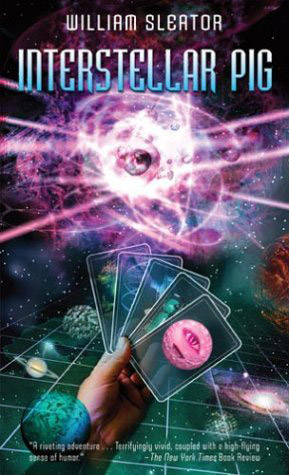
Initial Thoughts on Interstellar Pig

Really did not expect to like this book as much as I did!

Summary:
A cross between Jumanji and Men in Black? Sixteen year old Barney is on a boring vacation with his parents, but his trip gets more exciting when he learns of a ghost story, meets his strange visiting neighbors, and plays the board game “Interstellar Pig.”

Positives:
Writing flows smoothly. Well-paced. Intriguing plot. The board game is fun and clearly described. Characters were interesting and likable. Funny.

Criticism:
Really the only thing holding me back from giving it a five is that it’s not really my typical read and this book won’t go down in the all-time favorites. But I really, really liked it. Just probably won’t re-read it ever. Would definitely recommend it to people though.

Initial Thoughts on Isis Light

Summary: 
A girl who has lived on a planet all by herself must deal with settlers suddenly arriving and changing the home she has always known. 

Positives: 
Liked it more than I thought I would. But I’d heard a girl speak about the book… so I knew the big secret twist ahead of time. I might have liked it better if I hadn’t. The setting was vivid. The characters were pretty well-developed. 

Criticisms: 
Multiple times I thought the author’s word choice was awkward. The relationship between Orlen and Mark wasn’t developed thoroughly. The plot was predictable in parts. I didn’t particularly like the ending because it wasn’t hopeful or uplifting; no real resolution, just running away from the conflict.