Behind the Story: Author Sadism

Owl & White/Red BookBehind the Story posts will be about what goes on behind the scenes as a writer creates their story.  I’ll be writing about my own writing process and sharing any tips or advice I’ve discovered on my own or gathered on the topic. Hopefully both readers and writers find these posts fascinating!

This week’s topic:
Being Evil to Your Characters


Why would you want to be evil to your own creations?

  • To provide challenges and conflict
  • To create compelling characters who grow over the course of the story through the challenges they face
  • For suspense and pacing
  • As a plotting tool

This is one of those pieces of advice or writing tips that I don’t remember where I heard it.  But it really resonated with me, and is one of the first things I do when plotting a section of a novel.  I think it is a really, really valuable technique if you struggle with pacing, plotting, or giving characters agency.

Quotes About Being Tough on Your Characters

Editor, Cheryl Klein, Arthur A. Levine Books

Ten Ways to Create Compelling Characters
#6 Put the character in pain, danger, or jeopardy (anticipated pain)

Author, Kurt Vonnegut

8 Basics of Creative Writing
#6: Be a sadist. No matter how sweet and innocent your leading characters, make awful things happen to them—in order that the reader may see what they are made of.

Author, Maggie Stiefvater
Blog Post: Bringing Out Your Inner Sadist

“I have decided that in order to be a good writer, you have to be a sadist.”
“And that’s when I decided that I must have an inner sadist in there somewhere. Because although I love my characters dearly, I have to say, I also love to hurt them. I love to take away the stuff they need and the people they love and shove them outside their comfort zone without so much as a windbreaker. I like to make them uncomfortable, humiliate them, gun down their loved ones in cold blood, and give them pasts that will haunt them forever.”
“I think part of it is because of that saying: ‘Women are like tea bags. You never know how strong they are until they’re in hot water.’ Characters are like women which are like tea bags. You can learn a bit about them when things are going well, but it’s not until the proverbial poo hits the proverbial fan and plagues are raining down that you really see what sort of a person they are.”
“So I guess I figure that if a little pain and suffering will show me more about them, a lot of pain and suffering will do it even better. Basically, as soon as a character lets on what their worst fear is, it’s a pretty surefire sign that I am going to make them come face to face with it at some point in the novel. “
“I don’t think readers like it when you are nice to the characters. They think they want characters to be happy, but they don’t really. At least not until the characters have first been really miserable. I think a good writer finds their characters’ monsters and then resurrects them at the worst possible moment, and that we readers, like Jerry Springer audience members, love the angst and drama of it.”

Author, Janet Fitch

10 Rules for Writers
#10 Torture your protagonist.
 The writer is both a sadist and a masochist. We create people we love, and then we torture them. The more we love them, and the more cleverly we torture them along the lines of their greatest vulnerability and fear, the better the story. Sometimes we try to protect them from getting booboos that are too big. Don’t. This is your protagonist, not your kid.

The 22 rules of storytelling, according to Pixar:

#1: You admire a character for trying more than for their successes.
#6: What is your character good at, comfortable with? Throw the polar opposite at them. Challenge them. How do they deal?
#16: What are the stakes? Give us reason to root for the character. What happens if they don’t succeed? Stack the odds against.
#19: Coincidences to get characters into trouble are great; coincidences to get them out of it are cheating.

Ari Susu-Mago at blog “A Fuzzy Mango With Wings”
Blog Post: The Sadism of Fiction
(or, What Game of Thrones Can Teach Us About Writing)

“He makes likable, interesting, flawed, human characters. And then he makes their lives suck.”
“Moreover, note that not only does he make problems for them right at the beginning of the story, but he makes things get worse all the time. Rarely, if ever, do things get better. Plans go awry. People turn traitor. People get angry and say things they shouldn’t. People get killed. In general, more problems crop up. The result? A 800+ page book that flies by.”

Examples of Author Sadism:

Harry Potter and the Sorceror’s Stone by JK Rowling
How bad did JK Rowling make Harry’s aunt and uncle?
Rowling made them about as terrible as aunts/uncles can get.
How did the Dursleys keep Harry from his Hogwarts’ letter?
Rowling didn’t just hold Harry back from reading the letter, she took it to extreme levels by the Dursleys trying to hide on a rock in the middle of the sea.  By throwing so many obstacles in Harry’s path to reading the letter, it made us more invested in the story and increases suspense and tension.

Ender’s Game by Orson Scott Card
Everytime Ender became comfortable, Card threw him into a new challenge or worse situation.
Example:
Ender makes friends in his launch group and starts to be successful at the Battle School.
But then he is moved to Salamander Army where he is the smallest and most inexperienced, and Bonzo won’t even let him practice.

Downton Abbey
They make the audience care…
Then very briefly give them a glimpse of what they want…
Then they ruin or take it away…
(Examples: Anna/Bates or Matthew/Mary)

The Way I Incorporate this Technique in My Own Writing

Usually at the start of a work (or at the start of a new setting) I brainstorm a list of things that could go wrong either in the story or in that particular setting.

The list forces me to think of things that could go wrong and sets my brain thinking in that direction.  And I have a resource to refer to later if I need to.

When I sit down to start writing, I try to begin a chapter by resolving a previous problem or setting the stage for a new problem.

I try to always end a chapter in the midst of a low point for the protagonist.  It can be a physical low point or an emotional low point.

Writing Exercise:

Brainstorm a list:

  • Of things that could get in your protagonist’s way of their goal.
  • Of terrible things that could happen to your protagonist.
  • Of characters your protagonist needs in their life, and how they could disappear.

Don’t worry about how your character will get out of it, or how they’ll overcome it.
Don’t worry about how it will fit into your plot.
Don’t worry about how extreme it might be.

Links Quoted in this Post:

Maggie Stiefvater, Blog Post: Bringing Out Your Inner Sadist
http://m-stiefvater.livejournal.com/103969.html

Maggie Stiefvater, Collection of Posts on Writing
http://m-stiefvater.livejournal.com/214290.html

Kurt Vonnegut’s 8 Basics of Creative Writing
http://www.writingclasses.com/InformationPages/index.php/PageID/538/

Janet Fitch’s 10 Rules for Writers
http://latimesblogs.latimes.com/jacketcopy/2010/07/janet-fitchs-10-rules-for-writers.html

The 22 Rules of Storytelling According to Pixar
http://io9.com/5916970/the-22-rules-of-storytelling-according-to-pixar

Blog Post: The Sadism of Fiction
(or, What Game of Thrones Can Teach Us About Writing)
http://fuzzymango.wordpress.com/2012/06/17/the-sadism-of-fiction-or-what-game-of-thrones-can-teach-us-about-writing/

Ava Jae, of “Writablity: Tips, Tricks and Thoughts from One Writer to Cyberspace”
http://avajae.blogspot.com/2012/01/every-writer-should-be-sadist.html
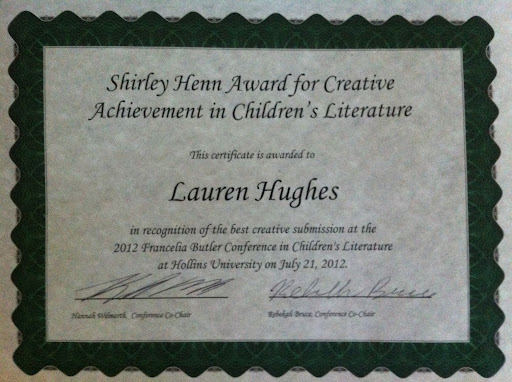
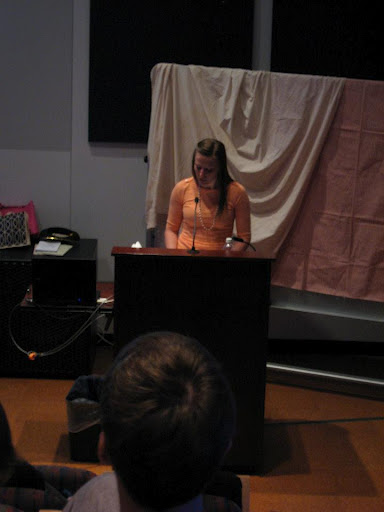
2012 Francelia Butler Conference Winner

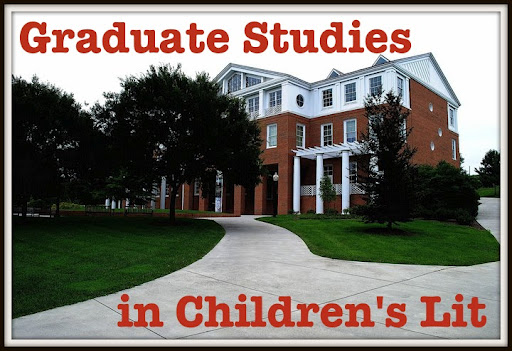
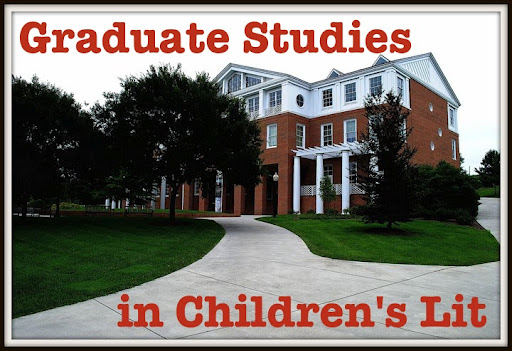
Each year at my graduate program, a conference is held to honor the work of the graduate students.  Students may submit work in each of the following categories: critical papers, creative stories, and original artwork to win one of three awards presented at the conference.

This was the first time I’ve ever entered any sort of writing contest.  The past two years I’ve simply attended this conference as an observer, and I did not enter anything in any of the categories.

There were 24 creative submissions this year, all from Hollins University MFA graduate students in Children’s Literature.

Last week, I learned my entry was one of the creative submissions selected to be read at the conference, and that my piece would be one of five pieces to go on to be judged by outside judges for the final honor of Best Creative Submission.  The judges for this year’s FBC conference were: Ashley Wolff (children’s book author and illustrator), Bruce Coville (children’s and YA author), and Michele Ebersole (Professor of Children’s Literature at University of Hawaii).

And… as you may have guessed by the title of this post… I won!

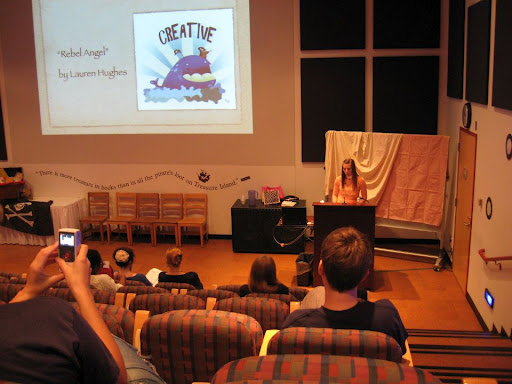
I entered the first 12 pages (first 3,000 words) of a short story I wrote in my Fantasy Genre Study course last summer.  The current title is “Rebel Angel” and the story is about a rebellious guardian angel who is sent to Earth on her first mission where she must save a boy from being recruited by a gang.

Below are pictures of me reading my selection at the conference.  I was nervous to speak in front of a crowd of adults as opposed to 11-14 year olds.  But after a lot of practice, all went smoothly.  A few funny parts in my story even got some laughs from the audience!  🙂

I was extremely honored to be recognized, especially knowing what talented writers are in my classes here at Hollins.  I only have one more week of classes left, and I think I can say that this summer has exceeded my expectations in almost every way.

Week 2 & 3 Grad Class Recap

I have had zero time to blog, which was quite unexpected.  Last summer I took three classes and it was really tough.  I am only taking two classes this summer, and I thought that would leave me with more time: to write, to blog, to read for pleasure.  But that has not been the case.

The culprits: Critique and Insane Weather

I really take critiquing my peers work seriously because I know how valuable feedback is to a writer.  And for some of my classmates who aren’t a part of a writing group, this is the only feedback they get.  I also believe it’s a give and take, people will spend more time on your work if you spend more time on theirs.  I’m taking two creative courses, and between both classes, I’m critiquing 16 people’s work per week and between 120-160 pages.  Or roughly, it’s been taking me 45 minutes to an hour per person.  So… I’ve been overwhelmed by critique.  Other than Saturdays and Sundays, I’ve had no time to write, much less blog or read for pleasure.  BUT!  I do think that being able to critique is a valuable skill.  And who knows… I’m not planning on teaching forever.  I could see myself enjoying being an editor someday…

And last weekend, here on the East Coast, we were hit by this thing called a “derecho.”  Had never heard of it before, but it resulted in high winds (gusts up to 80 mph) that tore down trees, tore some of the roof off the University Library, and killed power throughout the region.  This was extra horrible because the temps have been over 100 degrees and without power… we had no air-conditioning.  The University was without power for about 36 hours which was much better than most other areas.  (I know people who are still without power… now 7 days later.  Ugh.)  Below are some pictures that illustrate how torn up campus was after the storm:

Thanks to my friend and fellow blogger Caroline at ProseBeforeWoes for sharing her pictures!

Here’s a brief summary of what we’ve been up to in my classes!!!  ^_^

Dystopian and Science Fiction:

We went over common elements of dystopian fiction.  Some elements we discussed are dehumanization, control of information, loss of freedom, focus on society.  We’ve been using Orson Scott Card’s How to Write Science Fiction and Fantasy as a writing guide for our class.  It’s been very helpful.  During one class, we discussed chapter 3 in the book and talked about four different ways to structure your narrative (MICE: Milieu story,  Idea story, Character story, or Event story).  I discovered that one of my stories is a character story because the story revolves around my protagonist’s transformation.  Whereas, my dystopian story is an event story because the story revolves around the world making a transformation and being restructured from an event.

I also had a MAJOR revelation in regards to my dystopian WIP.  I’ve been frustrated because I didn’t know how to end my story.  Dystopian novels typically end one of two ways: revolution or escape.  Either the society/government is upended due to rebellion, or the protagonist runs away from the society they’ve grown to detest.  I wanted to find a new/different way to end my story.  And I did it!  I came up with an absolutely fabulous plot twist!!!  I’m so freaking excited.  I haven’t read any dystopian novel that does this, and I think I have something fresh on my hands.  And it allows for BRILLIANT sequel possibilities.

I also read Across the Universe for this class and will be posting a much delayed review of that this weekend as well.

Advanced Tutorial

My steampunk WIP for this class has been going much better than I expected.  I worried a little that the idea might be too strange and different.  But my class seems to be connecting with my characters really well.  They absolutely hate the characters I want them to hate and they love the characters I want them to love.  And they find my protagonist extremely sympathetic.  Yay!  I was also worried if I could pull off one of the settings… a factory… and have it make sense.  I haven’t exactly worked in a factory.  But they said my world-building is fantastic, and there’s been no confusion in how the factory is set up.  Double YAY!  And my pacing and plot are still strong.  As well as my “brushstroke” descriptions.  I don’t do heavy description.  I try to pick no more than three details to bring a character or setting to life.  I never do more than three, and I think it forces me to pick the three details that are most revealing and important.

There are still some things I need to work on.  My protagonist thinks in a puzzle-solving, scientific, mathematical way, and that’s hard for me to pull-off consistently because that’s not how I think at all.  I also need to do a better job of including my protagonist’s emotions and reactions to situations.  And I have my secondary characters down, but I need to add background people or tertiary characters to give my settings more vibrancy.  But I think for a first draft, I’m doing quite well.  And I sooooo appreciate both the constructive and positive feedback.  There is nothing more valuable to a writer than feedback!

I now have 10,620 words for my steampunk WIP.  Before the summer started I had sporadic key scenes and the first 1,600 words.  So I’m writing about 3,000 words a week which is great considering I’ve only had time to write on Saturdays and Sundays!  I trap myself in the library for 6-7 hours at a time and crank out the pages.  I’ve found I’m still doing a lot of research which slows me down a bit.  I’d love if I could hit 30,000 words before I leave for the summer.  We’ll see!

I am so, so, so behind in reading blogs.  I’ll read a post here and there on my iPhone when I’m stuck waiting somewhere, but it’s depressing how behind I am.  I’m going to try to do some commenting this weekend, but I’m not going to make any promises  😦  I still have loads of schoolwork to do.  But I promise to catch up at some point!

Movie Review: Brave

Brave
Disney / Pixar
Released: June 22, 2012
Rated PG

Summary:
Merida refuses to be wed off to one of three heirs to Scottish clans, and searches for a way to change her fate.

What I Loved:

The Animation
Pixar had to upgrade their software to handle Merida’s hair and the clothing details in the film.  Merida’s hair is pretty breathtaking.  I totally wanted to dye my hair red and get a perm. (Wonder if that will become a trend?)  The Scottish landscape, castle, and magical forest were beautiful to behold.  One reviewer claimed Brave’s animation “appears neither better nor worse than Madagascar 3 or The Lorax.” (link)  I disagree, and with a brother who specializes in 3D animation, I can see the difference in the level of detail, environment texture, use of light and shadows, and overall character design.  Brave is far superior in animation to films like Madagascar 3 or The Lorax and anyone who says otherwise clearly does not have a knowledge of the craft.

The Mother/Daughter Conflict
Merida is at battle with her mother over following traditions, accepting female gender roles, and submitting to an arranged marriage.  I thought this was a very organic conflict for the time period the film was set in, and yet still very poignant for today’s girls.  As a female in today’s world, I still experience conflict over how a female is expected to act and how to get what I want.  For example, I still feel like being sweet and compliant are traits expected from women, whereas confidence, assertiveness, and intelligence can get you labeled a cold b***h.  One male reviewer cites Brave had a “superficial girl-empowerment theme.” (link)  I take offense to that, and calling a movie that empowers women ‘superficial’ is sexist, especially when this is the first time Pixar has tackled women’s issues and what could be a risky move for them in a male-driven movie market.  I admired how Pixar handled the resolution to the conflict.  The mother represented traditional female values whereas Merida represented a more aggressive and assertive modern woman.  In the resolution, in order to break the spell cast on her mother, Merida had to use a blend of traditional and modern.  Merida had to sew a tapestry (domestic and traditional) as well as fight with arrow and sword (aggressive and modern).  I thought Pixar put a lot of thought into the women’s issues in the film and it gave the film a depth we haven’t seen in princess animated narratives.

The Humor
Our theater was wild with laughter from children to adults, girls to boys.  Parts of the movie were pretty scary and dramatic, so the humor was definitely necessary.  Most of the humor came from Merida’s brothers, the scheming and cake-loving triplets.  They were hilarious and adorable in their hijinks and mannerisms.  Another source of comedic relief were Merida’s suitors.  I particularly liked one suitor who spoke so incoherently that no one could understand him.  Merida’s mother also got several laughs from the audience, though I’ll refrain from giving away any plot spoilers.

The Celtic Mythology
The wisps, kilts, clans, bear lore, Scottish accents, tapestries, and other bits of Celtic culture gave this fairy tale a fresh feel.  It is a culture that hasn’t been explored in any recent animated feature films and was a welcome addition to the movie.

Word of Caution
The bears were quite scary and probably the reason that this animated feature has a PG rating instead of a G rating.

Overall Opinion
Brave was another outstanding movie from Pixar that I will be purchasing to go alongside my copies of Finding Nemo, Toy Story, and Wall-E.  Merida’s journey of discovery is magical, exciting, funny, and heart-warming.  I highly recommend this movie to people of all ages, but especially mothers and daughters who will be touched by the story’s conflict.

First Tutorial Critique

Today was our first critique in my tutorial class.  It was unusual because we read our work aloud and then critiqued it immediately after.  Because this is the first week of class, we didn’t have adequate time to critique work outside of class in just one day.  This is the only time we’ll be doing read aloud critiques, which is good!  I wasn’t a fan.  It felt rushed and I didn’t always have a copy of the story in front of me to follow along (and I’m very much someone who needs to follow along).  And it was hard to jot down notes and listen at the same time.

The project I’ve decided to work on for my Advanced Tutorial is an idea that came to me last summer and I just started working on this past winter.  It is very new, very rough, and today was the first time I shared it with the world.

What I’m willing to share online in terms of concept is I’m doing a steampunk twist of a piece of classic literature.  It will involve a strong heroine, clockwork creatures, ghosts, romance, and an evil lady who’s part of a secret society.

Critique Feedback

I got comments on good pacing which I consider my strength.  But I was nervous because the beginning of this particular project was backstory, and I was worried about the backstory being not engaging.  But my class LOVED the way I did the backstory!  Yay!

My class said I have memorable lines, vivid descriptions, and a nice blend of drama and humor.  I’m funny?  Didn’t think I was that funny, but I’ll take it.  And supposedly my main character has a mathematical and scientific view of the world in her voice that is intriguing… I really don’t know how I pulled that off, and I hope I can continue that voice through the rest of the novel.

In terms of constructive criticism, there were questions about age progression (I had issues with the age of the main character, so I expected that).  They wanted a scene with the mother.  And they wanted a description of the nursery setting.  All of which I will consider doing so long as it doesn’t mess with the pacing too much.  I like my pacing fast.

Next Thursday will be my first 20 page critique and I definitely have some writing to do this weekend… in a mathematical/scientific voice… yipes!  I really hope that comes out naturally because it wasn’t a conscious thing.

First Classes: Tutorial and Dystopian


Advanced Tutorial

This is a small class of six graduate students where the emphasis will be working on individual writing projects and critique.  We will be submitting 10-20 pages per week for critique as well as complete two presentations on aspects of the craft of writing that we are mystified by or struggling with.  I’ve chosen to do my presentation on point-of-view, specifically choosing third person or first person.

We also had a discussion on the high concept novel.  There were twenty-five principles that we looked at as being part of a high-concept novel.  A few of them are: original and unique concept, appeals to wide audience, a quintessential protagonist, a sweeping landscape, and a life-changing event.  The discussion and twenty-five principles definitely gave me some things to consider when plotting/outlining and some new writing terms to add to my craft vocabulary.

Genre Study: Dystopian and Science Fiction

I was incredibly psyched for this class, and I was not let down at all by the first class.  This class is larger at 12 students, but also has a creative emphasis.  We will be submitting 5-10 pages each week for critique, and the pages should be some form of science fiction.  We will be reading five novels (Across the Universe, Ender’s Game, Feed, Adoration of Jenna Fox, Matched) and using one writing handbook (How to Write Science Fiction and Fantasy by Orson Scott Card).  We will have discussions about the books and keep a reader response journal that is focused on craft.  Our journals should show that we are reading the novels as a writer and examining how an author was successful or unsuccessful in their novel by looking at aspects of their craft.

For the first class, we defined science fiction as a whole, and then defined many different sub genres of science fiction.  Here are the sub-genres we discussed:

  • Utopian
  • Dystopian
  • Ecotopian
  • Feminist Utopian
  • Hard Science Fiction
  • Soft Science Fiction
  • Cyberpunk
  • Time Travel / Time Slip
  • Steampunk
  • Alternate History
  • Superhuman
  • Military
  • Space Opera
  • Parody / Comedic
We finished class with a writing exercise, where we had to pick one of the sub-genres above that we would never normally touch… the sub-genre we would normally avoid.  We then had to come up with a protagonist, problem, reason for urgency to solve problem, something terrible in protagonist’s past, the worst thing that could happen to them, and how they would get themselves out of that lowest moment.  It was actually a fun exercise, that I’d like to repeat.
Two more classes this week, with first critiques!
I have to finish Across the Universe by Beth Revis this weekend because that’s the first book up for discussion, so a review of that book should be up on the blog soon!

TV Show to Watch: Legend of Korra

Yesterday, I posted about Brave and how animated feature films need more female characters in leading roles.  Today, I want to highlight a TV Show that is truly extraordinary and exemplifies an equal ratio of male/female characters and also has females starring in strong, leading roles.  So let me tell you why The Legend of Korra is so fantastic:

First off, let me start by saying that I’m not someone who watches a lot of anime or reads a lot of manga.  I have an awareness of it because of my students, but it’s a very surface level awareness.  Some things I respect about Japanese animation is how they embrace characters of all ages, explore complex plots, and delve into human emotions.

Legend of Korra is a sequel series to Nickelodeon’s American attempt at a cartoon series in the style of Japanese anime.  The first series, Avatar: The Last Airbender, aired from 2005-2008, was a roaring success (9.0 rating on imdb.com) with high praise from both viewers and critics.  I started watching it because of my younger brother, and discovered that it was even more worth watching than Spongebob.  As great as the original animated Avatar series was, I believe Legend of Korra might be better.  Here’s why:

Plot
The plot is much more complex than your average animated show.  It deals with issues such as prejudice, rebellion, and corruption.  The premise of this series is that there is a revolution in Republic City that targets and threatens a certain population (benders) because the general people (non-benders) have long felt powerless and controlled.  As the plot thickens, we learn new characters who are actually corrupt within the structure of the government and city.  Sometimes I wonder how much of this show is going over the heads of a kid audience.

Characters
The biggest reason this show is awesome is the characters.  They each have distinct personalities and roles in the story.  The ratio of female and male characters is even, but, oh-my-lordy, the female characters ROCK.  Let me highlight three of them:

Korra

First, there’s Korra, the lead character.  She’s strong, fiesty, and tough.  She doesn’t let anyone tell her what to do, which sometimes causes her to make mistakes, but they are mistakes that she deals with herself.  She’s the essence of a strong leading lady.

Asami Sato

Then, there’s Asami Sato.
She drives fast cars.
And motorcycles.
And wears fashionable leather outfits and takes off her helmet and shakes out her long, luxurious hair.
She can fight/defend herself.
And did I mention she’s drop dead gorgeous?
She’s fabulous.

Lin Beifong

And finally there’s Lin Beifong.
She’s the Chief of Police for the entire freaking city.
The Chief of freaking Police.
She can also fly through the air, knock people out, and see through the ground/walls.
She is one tough chick with some serious integrity.


Animation
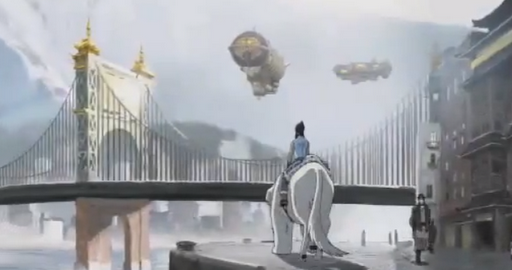
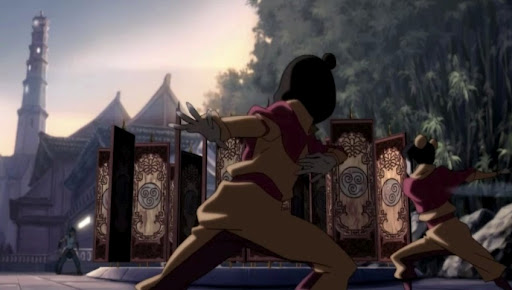
And finally, the animation is GORGEOUS.  Some scenes are actually breathtaking.  This is not the kind of animation you typically see in a TV show.  The quality is so high above everything else you see on TV, that just glancing at it, you should be able to see the difference.  The backgrounds often look like watercolor paintings.  Both city and landscape are beautiful.  Below are a few screenshots:

Oh wait, did I mention the series is steampunk?  Yup.  Airships, goggles, crazy gadgets, the whole deal.  It gives the show this fantastic edge and freshness that is so much fun.

If I did a good job and convinced you that you need to check this show out, some full episodes are currently streaming on Nick.com for free here.

I think the show would be easier to understand if you have the background from the original series Avatar: The Last Airbender, but if you don’t want to track down that series, you can read a summary here to give you a primer before Korra.  Mostly what you need to know is:

  • What is bending?  (Air-bending, water-bending, fire-bending, earth-bending)
  • What is the Avatar?  Why is the Avatar important?
If you can answer those two questions, then you’re set to watch Legend of Korra and enjoy!

Why it’s Critically Important to See Brave on Opening Weekend

This blog post is my attempt to awaken you to an issue, and to explain why it is so important that you see Brave on its Opening Weekend.

This is an issue that’s really important to me, and something I wasn’t aware of until I read this post by Shannon Hale.  I highly, highly recommend you read her post.  I kind of wanted to copy and paste the entire thing into my post, but that would be silly… so here’s a few of her main points:

  • Hollywood appeals to a male audience (even in animated films) because they assume guys won’t see films with female main characters whereas girls will watch anything.
  • If you were to look at the cast of characters of animated movies made in the last 10 years and count the number of male characters versus female characters, the ratio (about 1:10) would be completely imbalanced and unrealistically heavy on male characters.
  • The roles female characters do have in the story reinforce negative stereotypes in society for women: girls aren’t leaders, girls aren’t important enough to be main characters, girls don’t matter to the story, girls aren’t interesting, and girls aren’t funny.
So here’s my plea.  Pixar has made 12 feature films.  This is the first movie Pixar has made with a female main character.  Money sends a message to Hollywood, and Hollywood measures success based on a feature film’s opening weekend.
Here’s two scenarios:
  1. Brave has a solid opening weekend (because it’s Pixar and Pixar has a solid reputation), but Brave does not make as much money as other Pixar movies have made in their opening weekends.  This will send a message to Hollywood that having a female main character hurt sales and was a weakness of the film.  Pixar is then hesitant to make more films with female main characters.
  2. Moms and Dads, girls and guys, show up on opening weekend to see Brave.  Sales are high and equal to those of other Pixar films.  Hollywood sees that the gender of the main character is not a weakness/strength, and Pixar is encouraged to make more movies with strong female characters in lead roles.
This is why it is CRITICALLY important for all of us to support Brave in its opening weekend.  Please, send a message to Hollywood that we like to see girls in movies just as much as we like our boys.
And feel free to do your own post or link to my post to spread the word!  Support Brave this weekend!


*Sidenote* Japan doesn’t have the same gender issues as the US in their animated features.  The ratio is far more balanced and frequently have female lead characters.  I showed the movies Ponyo, Kiki’s Delivery, Spirited Away, and The Secret World of Arrietty (which all feature female main characters) to my majority male 11-12 year old students this year, and the kids LOVED them all.  And my heart melted a little when the boys in one class were cheering for Arrietty as she scaled a curtain with hooks and proclaiming how strong and ‘epic’ she was.  Boys WILL WATCH movies with girl characters.

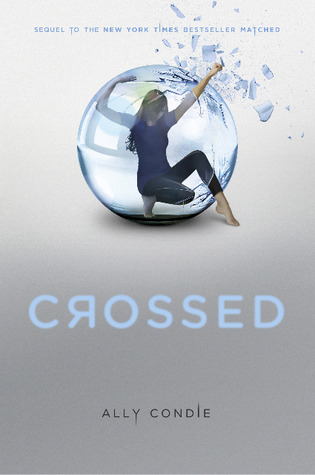
Book Review: Crossed

Crossed
by Ally Condie
Purchased/Kindle
Genre: Dystopian
Big Themes: Escape, Survival, Freedom, Love, Trust, Poetry

*Second Book in Series–Some Minor 1st Book Spoilers*
Summary: Cassia goes out in search of Ky, who was taken by the Society.  Ky struggles to survive where the Society has placed him.  While Cassia is searching, she learns more about the Rising, the rebel force that opposes the Society.

What I Liked:
Xander: I liked that he pops up throughout the novel, and that Cassia’s feelings for him are unresolved.  I still like Xander more than Ky.  Xander is strong, quick-witted, plotting, and supposedly handsome.  I’m hoping there will be much more of him in Reached.

Seeing both Ky and Cassia’s POVs: I liked knowing where each of them was and what they were thinking.  It allowed me to better understand Ky, and while I still don’t like him as much as Xander, I understand him a little better.

The Blue Tablet Twist: I don’t want to ruin this for anyone, but I liked this little development.  I don’t know if I like how it was handled with Cassia, but see my dislikes for how all the characters are being sheltered from real threat.

The Canyon Caves: This was an interesting and unique setting.  From the cave paintings, to the hidden tunnels, to the smell of sage, this made the setting memorable.  I do wish the setting had played a more active role in the plot because I think there were more possibilities for how the setting could have presented unique challenges or how the setting could have been used against the Society.

What I Didn’t Like:
Lack of Voice: While I liked getting both Ky and Cassia’s points-of-view, more than once I found myself getting confused as to who was narrating because their voices were indistinguishable.  I’d have to flip back to the start of chapter to see whose name was there.  Ky and Cassia are such different characters.  They should have different voices.  If the author was going to introduce a new narrator in the second book, then voice is something that should have been considered and addressed.

Lack of Threat/Tension: Characters die in this book.  The threat of the Society is referred to constantly. But do we ever see a character die at the hands of the Society?  No.  Every single death happens “off-screen.”  I have a problem with that because it seems to me that the author is sheltering and protecting her characters.  As a writer myself, I understand that your characters are your babies, but they have to experience the world.  Because all the deaths in this book happened off-screen, I never felt like there was a serious threat.  I never felt tension.  Did J.K. Rowling kill Sirius, Dumbledore, Dobby, Snape “off screen”?  No.  The threat of Voldemort was real.  The danger was real.  The characters weren’t sheltered.  What the author really needs to do for Reached, is make a list of every terrible thing that could happen to the characters, and then make the characters go through all those terrible things.  It forces the characters to grow and show you what they’re made off.  It keeps the reader on the edge of their seat.  It would make Reached an epic final book in this trilogy.  But I have my doubts as to whether that’s what will happen…

My Rating: Everyone was telling me that if I didn’t liked Matched, then I really wouldn’t like Crossed because it wasn’t very exciting.  So I went into the book expecting to hate it.  I didn’t hate it.  It was kind of just the same as Matched for me.  There were some parts that were interesting.  Some things that weren’t executed well.  I’d give it three stars.  I’ll probably still read Reached to finish out the trilogy (mostly for Xander).

And I have a theory about Dystopian trilogies…  And why they are tough to pull off as trilogies… And why Dystopias work better as stand alone novels…  But I’ll save that for after my Dystopian class this summer.  🙂

App I Love: Newsify

If you have an iPhone and you want a way to keep up with your Google Reader on the go, you should check out the Newsify app.  (It’s free!)

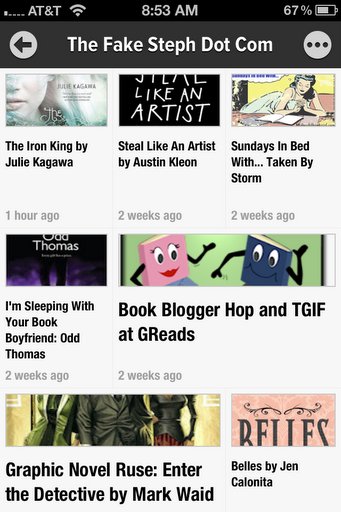
I downloaded it over the weekend, and I’m in love.  The app syncs with your Google Reader, and you can easily browse through all your subscriptions.  The layout is especially pleasing to the eye; blog posts are set up in squares with their titles, an image, and date posted.  See my screenshot below for a sample view:

I’ve been searching for a great app to read all my favorite blogs on the go, and this app has definitely done it for me.  The mobile version of Google Reader was not very friendly to the eye, and more challenging to navigate.  Newsify is pretty and easy-to-use.  Commenting on posts is still difficult, but for now I’ll read on the go, and comment at my leisure when I get home.

Anyone else use Newsify?  Or another app for reading blogs?